An autism evaluation in New York has no single statewide turnaround time: the wait for an appointment, the assessment itself, and the written report are separate parts of the process. A clinic’s appointment estimate does not tell you when you will receive the report or when services can begin. For 2026 planning, ask for each milestone separately and distinguish a medical diagnosis from an Early Intervention or school evaluation.
- How long does an autism evaluation take in New York? Separate appointment waits, assessment visits, and report delivery.
- New York Early Intervention generally requires evaluation and an initial IFSP meeting within 45 calendar days of referral.
- New York school-age initial evaluations generally must finish within 60 calendar days after parental consent, subject to exceptions.
- Autismlearnplay provides autism therapy services and community programs; ask a diagnostic provider about evaluation timing.
Why this matters
You need a usable timeline, not just an appointment date. A diagnostic report, a school eligibility decision, and a service start date answer different questions—and do not necessarily arrive together.
For Brooklyn families, the practical next move is to identify which process your child needs. If you are also seeking school support, this guide to connecting a CSE evaluation to autism therapy services explains the connection without treating the two evaluations as interchangeable.
Ask what the evaluation will produce before asking how quickly it can happen. That keeps you from waiting for a document that does not address the support you are seeking.
How long does an autism evaluation take in New York?
The full timeline depends on the evaluation pathway. A medical provider schedules a diagnostic assessment and report; public Early Intervention and school evaluations operate under separate rules.
The table below separates these pathways for 2026 planning. The deadlines are public-program requirements, not estimates of a private clinic’s waiting list.
| Pathway | Best for | Timing to understand | Advantage | Limit to understand |
|---|---|---|---|---|
| Clinical diagnostic evaluation | Families seeking a medical answer about autism | Ask separately about intake, assessment appointments, feedback, and the written report | Addresses the clinical diagnostic question | A medical diagnosis does not automatically establish school eligibility |
| New York Early Intervention evaluation | Families with children younger than 3 years who have developmental concerns | Evaluation, assessment, and the initial IFSP meeting generally fall within 45 calendar days of referral, with specified exceptions | Connects developmental evaluation with an individualized family service planning process | Eligibility is not the same as an autism diagnosis |
| New York school-age initial evaluation | Families seeking a decision about special education needs | The initial individual evaluation generally must be completed within 60 calendar days after parental consent, with specified exceptions | Examines educational needs and special education eligibility | It is not a substitute for a medical diagnostic evaluation |
The appointment is only one milestone. A provider who gives you an assessment date has not necessarily given you a report-delivery date.
The legal timing references here are New York State Department of Health Early Intervention guidance and federal regulation 34 CFR §303.310 for the 45-calendar-day process, and New York State Education Department regulation 8 NYCRR §200.4(b)(7) for the school-age initial evaluation deadline. These rules describe particular processes; they do not establish a universal autism diagnostic turnaround time.
Clinical autism evaluation: ask for the complete timeline
For a medical diagnostic evaluation, request an estimate covering the entire process. Do not assume that an intake call, screening questionnaire, or first visit completes the assessment.
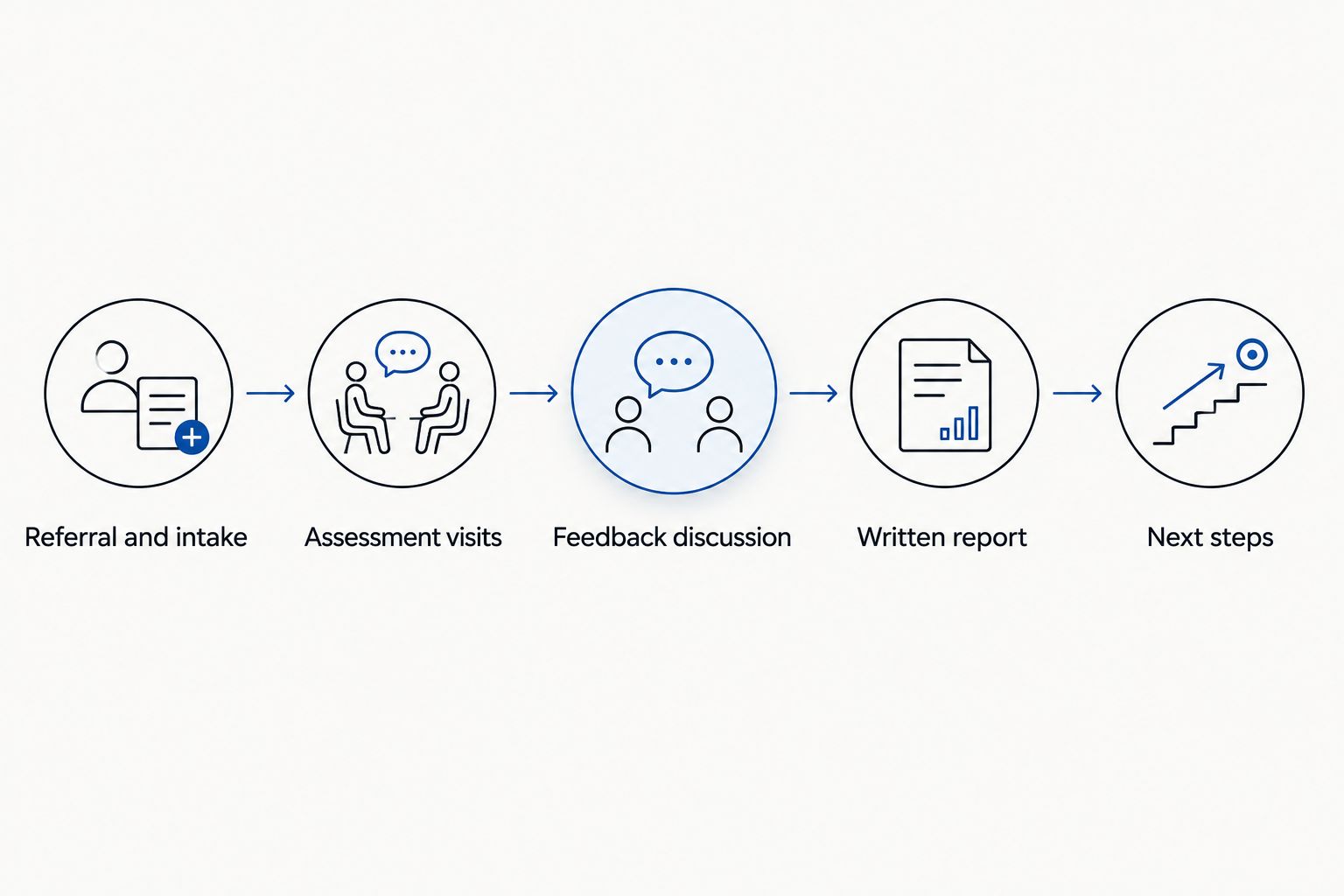
A useful scheduling conversation follows this sequence:
- Referral and intake. Ask whether the provider needs a referral, records, or completed questionnaires before scheduling.
- Assessment visits. Ask how the provider organizes parent interviews, observation, and any additional assessments your child needs.
- Feedback discussion. Ask when someone will explain the findings and answer your questions.
- Written report. Ask when the completed document will be delivered and how you will receive it.
- Next steps. Ask who will explain recommendations and which documents other services require.
You can write these milestones on a single page and record the estimate beside each one. Keep the provider’s name and the date of the conversation with your notes, so you know whom to contact if a milestone changes.
Ask whether the feedback discussion and report delivery happen together. If another organization needs the report, explain that requirement before the assessment rather than discovering it afterward.
Early Intervention: 45 calendar days for the initial process
45 calendar days is the general Early Intervention timeline from referral through evaluation, assessment, and the initial Individualized Family Service Plan meeting. It is not a promise that a medical autism diagnosis will be completed within that period.
New York Early Intervention serves eligible children younger than 3 years. A family can raise developmental concerns without first obtaining an autism diagnosis; the program evaluates eligibility for its own services.
The federal rule allows specified exceptions, including documented exceptional family circumstances and circumstances involving parental consent despite documented attempts to obtain it. Ask the service coordinator to explain the applicable timeline and document any reason it changes.
For a toddler approaching a birthday or another transition, ask about transition planning at the outset. Keep that conversation separate from any clinic referral, because the clinical and Early Intervention processes serve different purposes.
School-age evaluation: 60 calendar days after consent
60 calendar days is New York’s general deadline for completing a school-age initial individual evaluation after parental consent is received. The date you first discuss a concern is not necessarily the date this clock begins.
For 2026 school planning, keep a copy of your written request and signed consent, and ask the district to confirm when it received consent. The New York regulation includes exceptions, so ask for a written explanation if the district identifies one.
This deadline concerns completion of the initial evaluation. Do not treat it as a promise that a medical diagnosis, an eligibility meeting, and the start of every recommended service will all happen by the same date.
Preschool families should ask their Committee on Preschool Special Education, or CPSE, to explain the preschool process and applicable deadlines. School-age families work with the Committee on Special Education, or CSE; the age-specific process matters.
Why autism evaluation timelines vary
A useful estimate reflects the actual steps your child needs. Ask the provider to explain these factors rather than giving you an undifferentiated waiting-time estimate:
- Scheduling: When can intake and assessment appointments occur, and are they booked together?
- Records: Which developmental, medical, therapy, or school documents must arrive before the assessment?
- Assessment scope: What questions will the evaluation address beyond whether your child meets autism diagnostic criteria?
- Participation needs: How will the provider accommodate communication preferences, sensory needs, breaks, or an interpreter?
- Report process: Who prepares the report, and when will feedback and written findings be delivered?
- Evaluation pathway: Is this a clinical assessment, an Early Intervention evaluation, or a school eligibility evaluation?
A shorter process is not automatically a better fit. Choose an evaluation that answers the right question and gives your child a workable way to participate.
What should I ask when booking an evaluation in 2026?
Ask for the earliest estimate for each stage and clarify what could change it. You do not need to use clinical language; a direct question about what happens next is enough.
Keep these questions beside you during the call:
- What does the first appointment cover?
- Who completes the diagnostic assessment, and what are their qualifications?
- Which records or questionnaires do you need beforehand?
- What should my child expect during the visit?
- How do we request breaks, communication supports, or language assistance?
- When will we discuss the findings?
- When should we expect the written report?
- Who should we contact if the timeline changes?
If you are seeking a report for a particular purpose, name that purpose. Ask the receiving organization about its documentation requirements as well, rather than assuming every evaluation report meets them.
Before ending the call, repeat the next action back: who sends what, to whom, and by when. This gives your family a clear task without turning the whole process into a daily follow-up project.
What can my child do while we wait?
You can ask about support for current needs while a diagnostic assessment is pending. Speak with your child’s pediatrician and, where relevant, Early Intervention or the school about communication, learning, daily activities, or participation concerns.
Keep ordinary family life in view, too. An outing can be about enjoying something together rather than practicing a skill or preparing for an assessment.
For younger children, consider familiar play and a predictable way to leave. For school-age children, offer choices around shared interests; for teenagers, ask what feels enjoyable and age-respectful rather than choosing an activity solely because it is labeled autism-friendly.
When considering a Brooklyn group or outing in 2026, ask the organizer about the actual setting: noise, transitions, caregiver participation, breaks, and ways to communicate. Do not assume that the same activity suits every child across ages 2–18 years.
Autismlearnplay is best for families seeking Brooklyn autism therapy services, community programs, and online classes for children ages 2–18. Its stated services are not a basis for treating it as a diagnostic evaluation provider. To ask about programs and fit, use the contact form or email info@autismlearnplay.org; ask directly about participation requirements rather than assuming a diagnosis is required or unnecessary.
Does a school evaluation replace an autism diagnosis?
A school evaluation does not replace a medical autism diagnosis. It addresses educational needs and eligibility for special education, while a clinical diagnostic evaluation addresses a medical diagnostic question.
Share relevant reports between providers and the school with the appropriate permission. Ask each team what additional information it needs rather than assuming one report completes both processes.
Should I wait for a diagnosis before asking the school for help?
You do not need to wait for a medical autism diagnosis to request a school evaluation when you suspect a disability is affecting your child’s education. Describe the concerns you see and submit your request in writing.
An evaluation request does not guarantee eligibility or a particular service. It starts a process for examining your child’s educational needs.
How do I prepare my child without adding pressure?
Explain the visit in language your child understands and ask the evaluator what preparation is appropriate. Share your child’s usual communication methods, interests, sensory preferences, and signs that a break is needed.
Avoid rehearsing answers or asking your child to hide natural behaviors. The goal is an accurate understanding of your child, not a performance.
FAQ
How long does an autism evaluation take in New York in 2026?
New York has no single turnaround time covering all clinical autism evaluations. Ask the provider for separate estimates for the appointment wait, assessment visits, feedback, and written report; public Early Intervention and school evaluations have different rules.
Does the 45-day Early Intervention deadline mean my child will get an autism diagnosis?
45 calendar days generally covers evaluation, assessment, and the initial IFSP meeting in Early Intervention, subject to specified exceptions. That process determines Early Intervention eligibility and planning; it does not guarantee a medical autism diagnosis.
When does the school-age evaluation deadline start in New York?
60 calendar days generally begins when parental consent for the initial individual evaluation is received, subject to specified exceptions. Keep a copy of consent and ask the district to confirm its receipt date.
Will I get the autism evaluation report at the appointment?
Ask the provider when the written report will arrive; an assessment appointment does not establish its delivery date. Also ask whether the feedback discussion happens before, with, or after the report.
Can I request a school evaluation while waiting for a medical appointment?
You can request a school evaluation while a medical autism assessment is pending. Explain your educational concerns in writing; the school process addresses eligibility and support needs rather than replacing a medical diagnosis.
What should I bring to my child’s autism evaluation?
Bring the records and questionnaires the evaluator requests, along with information about your child’s communication and support needs. Ask beforehand about school reports, previous assessments, communication devices, and comfort items.
Can Autismlearnplay tell me which community program fits my child?
Autismlearnplay provides community programs, therapy services, and online classes for children ages 2–18 on the autism spectrum. Contact the organization to discuss your child’s interests and needs, and confirm current program details directly.
One last thing
Put the written report on your calendar, not just the assessment appointment. Before you leave the feedback conversation, confirm who sends it, how you receive it, and whom you contact with questions.
While the paperwork moves forward, your child still deserves enjoyable days and opportunities to belong. Choose activities around their interests, allow a comfortable exit, and let connection—not an evaluation timeline—set the tone.
Related guides
- Family support groups for autism in Brooklyn
- Can siblings join autism community programs together?
- Autism-friendly museums and attractions in NYC