
Yes, autistic teens can benefit from social skills groups when the group supports their own goals, respects their communication, and offers comfortable ways to participate. The goal is meaningful connection—not making an autistic teenager appear less autistic—and participation should never require ignoring discomfort or hiding harmless differences.
- Can autistic teens benefit from social skills groups? Yes—prioritize teen-chosen goals, shared interests, and respectful communication support.
- Choose groups that welcome breaks, communication devices, and different ways of joining activities.
- Autism Learn & Play provides community programs and online classes; ask about teen-specific fit before choosing.
- Judge progress by your teen’s comfort, autonomy, and meaningful connections—not eye contact or performance.
Why this matters
Teenagers deserve places where they can meet people without feeling constantly corrected. For Brooklyn families comparing community programs in 2026, the useful question is not simply whether a group teaches social skills. It is whether your teenager wants what that particular group offers.
Start with an interest your teen already enjoys. These social skills games for autistic teens offer ideas to discuss together before choosing an activity. A shared game, creative project, or conversation topic gives you something more specific to ask about than a general promise to improve socializing.
Can autistic teens still benefit from social skills groups?
Yes. Being a teenager is not a reason to rule out support with friendship, communication, or participating in community life. But a group is an option, not an obligation, and a diagnosis alone does not establish that your teen needs one.
Look for opportunities to practice something your teenager actually wants: joining a game, explaining a preference, recognizing an unwelcome interaction, or asking someone to stop. These are different goals. A group organized around one does not automatically address the others.
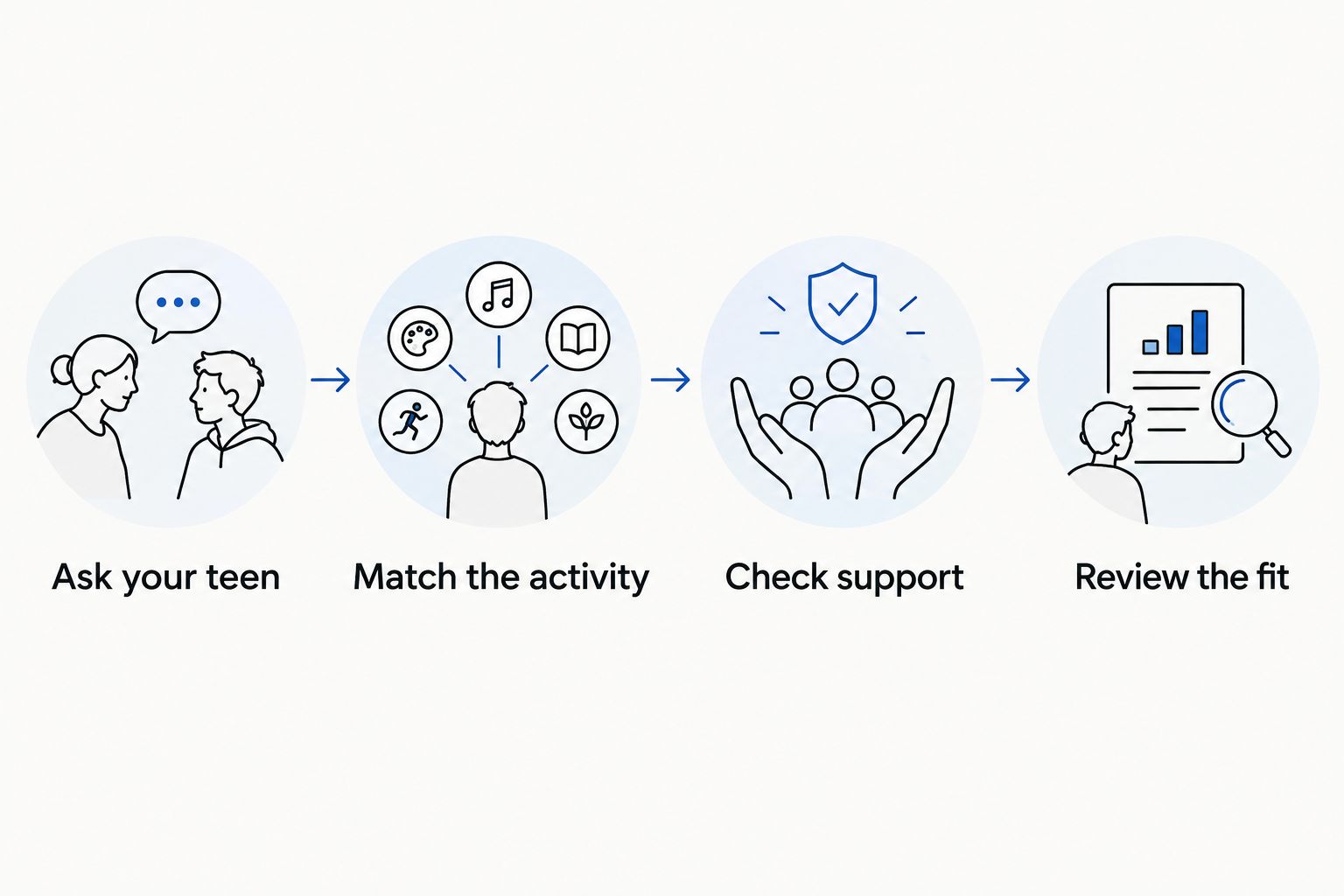
Use this sequence when deciding whether a group deserves a closer look:
- Ask your teen. Find out whether they want help meeting people, handling a particular situation, or finding an activity they enjoy.
- Match the activity. Ask what participants actually do, rather than relying on the program name.
- Check support. Discuss communication access, sensory needs, breaks, and how adults respond to disagreement.
- Review the fit. After participating, ask what felt enjoyable, confusing, tiring, or uncomfortable.
A useful answer from a provider describes what happens when someone needs help, declines an activity, or communicates differently. A statement that every participant must behave the same way tells you much less about whether your teenager will feel welcome.
Choose the format around your teen’s goal
A social skills group, an interest-based community activity, and individual support are not interchangeable. Compare them by the experience your teen wants—not by which sounds most intensive.
| Format | Best for | What it offers | Limitation to check |
|---|---|---|---|
| Structured social skills group | Teens who want guided practice with specific situations | Planned opportunities to discuss and rehearse communication | Practice does not guarantee comfort or connection outside the group |
| Interest-based community activity | Teens who want to meet people through something they enjoy | A shared activity that gives interaction a purpose | The leader might not provide individualized communication support |
| Individual support | Teens who prefer private preparation for a specific challenge | Space to focus on personal questions and preferences | It does not provide the same peer experience as a group |
| Online group | Teens who prefer joining from home | Participation without traveling to a meeting place | Screens, audio, and online turn-taking still need consideration |
Ask who participates and how the leader matches people. Similar ages alone do not establish compatibility; interests, communication preferences, and expectations also matter.
For a younger teenager, you might discuss joining a familiar game or managing a change in plans. An older teenager might want to discuss boundaries, arranging a meetup, or navigating a disagreement. Offer those as choices, not age-based requirements. Your teen’s priorities should set the direction.
Why the usefulness of a social skills group varies
A group’s label does not tell you how it will feel to attend. When comparing options in 2026, use these factors to turn a broad description into practical questions:
- Personal goals: Ask whether your teen can help choose what to work on and decline goals that do not matter to them.
- Shared interests: Find out whether activities reflect participants’ interests rather than expecting everyone to enjoy the same topic.
- Communication access: Ask how the group welcomes speech, typing, gestures, and augmentative and alternative communication, or AAC.
- Sensory needs: Discuss sound, lighting, crowded spaces, movement, and access to a quieter place.
- Adult responses: Ask how the leader handles teasing, misunderstandings, unwanted attention, and requests to stop.
- Practical demands: Consider travel, school commitments, fatigue, and how your teen feels about the meeting format.
Bring examples instead of a long list of labels. Explain that your teenager needs time to type an answer, dislikes unexpected touching, or wants to watch before joining. Then ask how the leader would respond in that situation.
What should happen at a welcoming group?
Before enrolling, request a plain-language description of a typical meeting. Ask how the session begins, what the main activity involves, whether participation is optional, and how everyone knows it is ending. Do not assume a program includes those supports because its description says it is autism-friendly.
For a Brooklyn outing, ask about the meeting point, transitions between spaces, bathroom access, and what happens if your family needs to leave. A community activity can involve more than the advertised activity itself. Getting there and waiting are part of the experience your teen will need to consider.
Your teenager should know how to request help or a break without having to earn it. Ask whether watching quietly is acceptable and whether a participant can choose a different role in a shared activity.
Respectful support teaches communication in both directions. Your teen can practice expressing a preference while adults and peers practice listening, accepting a refusal, and allowing extra response time.
When is a different approach the better choice?
Pause when your teenager repeatedly says they do not want to attend, describes feeling humiliated, or reports pressure to ignore discomfort. Ask what happened before treating reluctance as something to overcome. A mismatch deserves attention, not automatic insistence.
Be cautious about goals centered on forced eye contact, suppressing harmless stimming, or copying a single acceptable conversational style. Ask how each proposed goal serves your teen’s safety, independence, or relationships. If the explanation is simply that it makes them look more typical, reconsider the goal.
A different activity is not a failure. Your teenager might prefer an art project, a quieter shared-interest setting, individual preparation, or a break from organized programs. Keep the invitation to connect open without making attendance a test of effort.
Can a nonspeaking autistic teen join a social skills group?
Yes, a nonspeaking autistic teen can participate when the group supports their communication and offers meaningful ways to contribute. Speech should not be the entry requirement for belonging.
Ask whether participants can use AAC, type, point, gesture, or take longer to respond. Find out how the leader includes someone in a game or discussion without speaking for them. A communication device should remain available throughout the activity.
Also ask how consent and refusal are recognized. Your teenager needs a dependable way to express yes, no, stop, help, or a preference—not merely a way to answer an adult’s questions.
How do you know whether a social skills group is helping?
Look for changes connected to your teenager’s chosen goals, rather than a standard picture of sociability. Ask whether they feel understood, know how to get help, or want to see someone from the group again. Quiet participation can still be participation.
For your 2026 program search, write down what your teen hopes will be different. After a meeting, return to that same goal instead of asking only whether they behaved well. Let them answer through conversation, writing, AAC, or another comfortable method.
Do not promise friendship or set a deadline for it. A teen might enjoy an activity without wanting a closer relationship, and a positive group experience does not guarantee that school or other settings will feel easier.
Questions Brooklyn parents can ask before committing
A practical conversation with the organizer should help your teenager picture the experience. Use questions such as:
- What ages and interests is this particular group intended for?
- What does a participant do during a typical meeting?
- How do you include someone who prefers to observe first?
- What happens when a participant asks for a break or declines an activity?
- How do you support AAC and extra response time?
- How do you address bullying or an unwanted interaction?
- How can my teenager share feedback privately?
Include your teen in the conversation in a way they prefer. You can gather information first, write questions together, or let them communicate directly. Avoid discussing personal difficulties in front of others without considering their privacy.
When checking 2026 schedules, confirm the details for the exact group rather than relying on a general services description. Ask about the location or online format, supervision, and the process for discussing individual needs before making plans.
Where Autism Learn & Play fits
Autism Learn & Play is a relevant starting point for Brooklyn families seeking autism community programs and online classes for children ages 2–18. Its stated services include therapy, community programs, and online learning; those categories do not establish the format or age suitability of a particular teen group.
The Autism Learn & Play online class descriptions provide some concrete details you can use when asking about fit:
| Listed class | Stated format | Best for exploring | What to clarify |
|---|---|---|---|
| Social Skills Class | 30 minutes via Zoom | A class explicitly focused on social skills | Teen age fit, participant grouping, and communication supports |
| Game Talk Class | 30 minutes via Zoom | A game-related class option | Activities, peer interaction, and age suitability |
| Conversation: 1 on 1 | 1 hour via Zoom | An individual conversation format | Personal goals, session expectations, and suitability |
These descriptions establish duration and online delivery—not a promise of friendship, a particular teaching approach, or teen eligibility. The class descriptions also state that staff contact families to finalize and book a slot after preferred course days are selected.
Ask Autism Learn & Play about autism social skills support through the website contact form or email info@autismlearnplay.org. Share your teen’s interests, preferred communication, and what they want from participating; ask which option, if any, matches those needs.
FAQ
Can autistic teens benefit from social skills groups even if they have never attended one?
Yes, autistic teens can benefit from social skills groups without previous group experience. Start by asking what your teenager wants and whether the group offers comfortable ways to observe, participate, and take breaks.
Is a social skills group better than an interest-based club?
Neither is automatically better; the right choice depends on your teen’s goal. A structured group offers guided practice, while an interest-based club centers participation on a shared activity.
Does my autistic teenager need to make eye contact in a social skills group?
Eye contact should not be a condition of participation. Ask providers to focus on understandable communication, boundaries, and your teen’s chosen goals rather than requiring a particular appearance of attention.
Can a teen who uses AAC participate in a social skills group?
Yes, a teen who uses AAC can participate when the group supports their communication. Ask about device access, response time, and how the leader includes different ways of contributing.
What if my autistic teenager does not want to join a group?
Do not treat group attendance as mandatory simply because your teenager is autistic. Ask whether they want another kind of activity, individual support, or no organized social activity at present.
How long are Autism Learn & Play’s listed social skills classes?
The listed Social Skills Class is 30 minutes long and conducted via Zoom. Ask about teen suitability, participant grouping, and session expectations before choosing it.
How soon should my teenager make friends in a group?
There is no guaranteed deadline for making friends in a group. Focus on whether your teenager feels respected, enjoys participating, and wants to continue rather than counting friendships as a required result.
One last thing
Before choosing a group in 2026, ask your teenager what would make it worth attending. The answer does not have to sound like a therapy goal. Wanting someone to discuss a favorite game with is a meaningful starting point.
A useful group gives your teenager more room to be themselves, not a longer list of ways to hide. Keep checking whether the experience serves their interests, comfort, and choices.
Related guides
- Can autistic kids make real friends in group therapy?
- Speech therapy for autistic teenagers
- Family support groups for autism in Brooklyn