
A child with autism should attend occupational therapy on a schedule set after an individualized evaluation—not a fixed number of visits based on diagnosis alone. In 2026, ask the occupational therapist to explain how the recommended frequency supports your child’s daily activities, how progress will be reviewed, and how appointments will leave room for rest, school, play, and friendships.
- How often should a child with autism attend occupational therapy? Base the schedule on assessed needs and meaningful daily goals.
- Ask the occupational therapist to explain session frequency, home support, and when to review the plan.
- Autism Learn & Play provides occupational therapy services for autistic children; discuss your child’s needs before choosing a schedule.
- Protect time for rest, friendships, and community activities rather than filling every opening with therapy.
How often should a child with autism attend occupational therapy?
The right frequency is the frequency your child’s occupational therapist can connect to specific needs, goals, and a review plan. An autism diagnosis does not, by itself, tell you how many appointments belong on your calendar.
Ask for a recommendation that distinguishes direct sessions from caregiver guidance, school support, and everyday practice. These are different parts of a plan, not interchangeable appointments.
| Support approach | Best for discussing when… | What to clarify | Limitation to consider |
|---|---|---|---|
| Recurring direct sessions | Your child needs ongoing therapist involvement with a defined daily activity | What happens during visits and how the schedule supports the goal | Travel and appointments take time from other activities |
| Caregiver consultation | You need help adapting routines or using therapist-recommended supports | What guidance you will receive and how follow-up works | Consultation does not replace direct assessment or treatment when needed |
| Coordinated school and outside support | Your child has goals in more than one setting | Which provider addresses each goal and how information is shared | Separate plans require communication to avoid duplication |
| Review before changing frequency | Your child’s needs, comfort, or participation have changed | Whether to adjust goals, approach, setting, or frequency | Changing the calendar alone does not explain the underlying difficulty |
For ideas to discuss with your therapist, explore these occupational therapy activities for autism at home. Choose activities together rather than treating a general activity list as your child’s treatment plan.
Why this matters
Your child’s schedule should support their life, not become their whole life. For Brooklyn families, a therapy appointment also involves getting ready, traveling, waiting, and settling back into the day.
When planning your 2026 calendar, count that whole experience. A session that looks manageable on paper still needs to fit around meals, school, siblings, and your child’s preferred downtime.
Keep the purpose concrete: getting dressed with less unwanted help, participating comfortably in an art activity, or using classroom materials. Those goals make a frequency discussion more useful than asking whether your child receives as much therapy as another child.
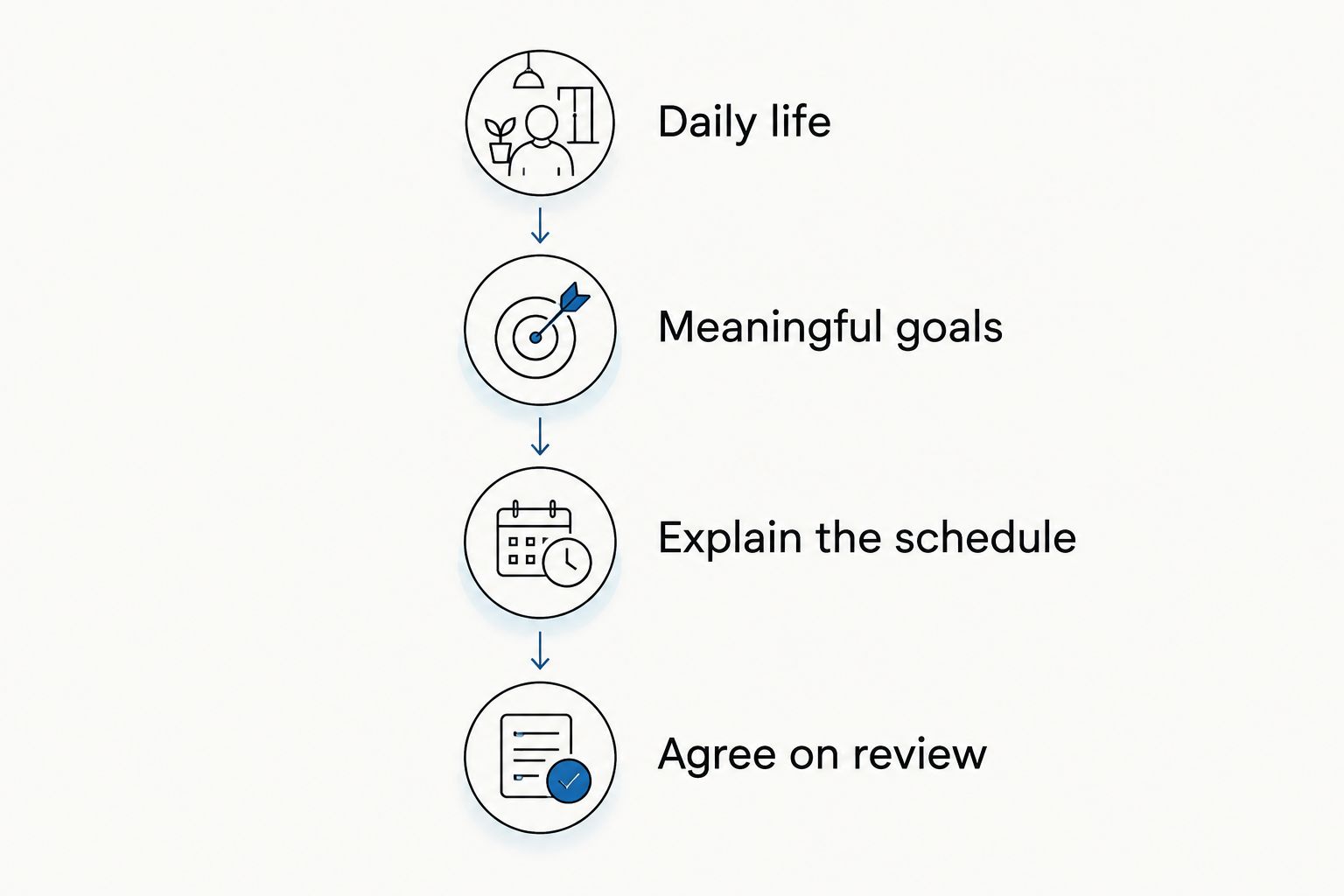
How to decide on a workable occupational therapy schedule
A useful recommendation answers more than how often to attend. You should understand what your child is working toward, what support looks like, and what would prompt a change.
Start with daily life
Before an evaluation, write down activities your child enjoys and activities they find difficult. Include what happens before, during, and after the difficult activity without labeling your child as uncooperative.
For example, describe whether getting dressed becomes difficult when clothing touches the skin, when fasteners are involved, or when everyone is rushing. You do not need to identify the cause yourself; give the therapist a clear picture to explore.
Choose meaningful goals
Ask your child what they want help with, using their preferred communication method. For a younger child, notice what they approach, avoid, request, or enjoy.
A useful goal improves access, comfort, choice, or participation—not simply how typical a child appears. Ask the therapist to explain how each proposed goal matters in your child’s everyday life.
Explain the schedule
Ask why the therapist recommends that particular appointment pattern. The explanation should connect the schedule to the evaluation, the planned work, and opportunities to use supports outside sessions.
Also clarify who needs to attend and what preparation is expected. A plan that depends on extensive caregiver participation needs to account for your family’s actual capacity.
Agree on review
Before starting, ask when you will discuss whether the plan still fits. Decide what information you will bring, such as your child’s feedback, examples from home, or observations shared with permission by school staff.
Do not use appointment attendance as the only measure of success. Ask what meaningful change would look like and what the therapist will reconsider if that change is not happening.
Why occupational therapy frequency varies
Use these factors as discussion points, not a formula for calculating visits. Your occupational therapist should explain which ones shape your child’s recommendation.
- Daily priorities: Identify the activities your child wants or needs help accessing, rather than collecting unrelated therapy goals.
- Type of support: Clarify whether the plan involves direct treatment, environmental changes, caregiver guidance, or a combination.
- Your child’s experience: Bring their preferences, communication, comfort, and response to sessions into the discussion.
- Support across settings: Explain what school staff, other providers, and family members already do so responsibilities are clear.
- Family capacity: Include travel, work, caregiving, and realistic opportunities to use recommended strategies.
- Changing needs: Revisit the plan when routines, goals, health, or participation change rather than keeping a schedule automatically.
For your 2026 planning, separate clinical recommendations from scheduling convenience. If the proposed appointment pattern does not fit your family, ask the therapist to discuss alternatives and their trade-offs rather than quietly struggling to maintain it.
What should families consider at different ages?
Age helps frame the conversation, but it does not determine frequency. The following age groups are planning examples, not treatment rules; interests, communication, and support needs differ within every group.
Ages 2–5: discuss play and family routines
For children ages 2–5, bring examples from play, dressing, mealtimes, and transitions. Ask how the therapist will make participation understandable and respond when your child communicates discomfort or wants a break.
Keep family priorities visible. If getting out the door is already difficult, explain that before agreeing to a plan that adds more transitions to the week.
Ages 6–12: connect goals across the day
For children ages 6–12, discuss classroom tasks alongside home routines and preferred activities. Ask whether a concern involves the task, the materials, the environment, or the support available.
If your child has an individualized education program, bring relevant information to the discussion. This guide to connecting a CSE evaluation to autism therapy services offers a related starting point for organizing questions about school and outside support.
Ages 13–18: put the teenager’s priorities first
For teenagers ages 13–18, ask directly which activities they want to make easier or more comfortable. Discuss privacy, personal routines, school demands, hobbies, and community participation without assuming every teenager shares the same independence goals.
Protect time with friends and interests when building the schedule. Therapy planning should include the teenager’s preferences, not only the adults’ priorities.
How do you know whether the schedule fits?
Look beyond what happens inside the appointment. Ask whether the goals remain relevant and whether your child can use the agreed supports in the settings that matter to them.
Keep brief, descriptive notes instead of turning home into a testing environment. An entry such as your child choosing a different shirt and finishing dressing comfortably gives the therapist something concrete to discuss.
Bring difficulties too. If sessions leave your child distressed, recovery takes over the afternoon, or recommended activities repeatedly lead to conflict, contact the therapist to review the approach and schedule.
Persistent distress is a reason to ask questions, not proof that your child needs more appointments. Ask what can change in the environment, communication, expectations, or treatment approach.
Does more occupational therapy always mean better support?
More appointments are not automatically a better plan. Ask what an additional visit would address and how the therapist would judge whether it helps your child work toward the agreed goal.
Consider the trade-off openly. Adding appointments removes time from somewhere else, including sleep routines, unstructured play, preferred interests, or community outings.
For 2026, put those activities on the calendar before treating every unfilled space as a therapy opportunity. Your child deserves a life that includes support and enjoyment.
Can home activities replace occupational therapy sessions?
Home activities are not a substitute for an individualized occupational therapy evaluation or prescribed treatment. Ask the therapist which everyday activities support your child’s goals and how to adapt them safely.
Choose something that already belongs in your routine when possible. Ask what to watch for, when to stop, and how to respond if your child does not want to participate.
Keep the distinction clear between enjoyable activities and professional services. A drawing activity, dance session, or playground visit should not be described as occupational therapy unless it is part of care delivered by an appropriately qualified professional.
How should Brooklyn families discuss services?
Autism Learn & Play is a fit for Brooklyn families seeking a nonprofit that provides occupational therapy and other autism services for children ages 2–18. Its services also include community programs and online classes, but those offerings do not establish which occupational therapy schedule suits your child.
Ask about an evaluation, the proposed goals, and how your child’s preferences would shape the plan. Confirm service details directly rather than assuming a class description explains therapy delivery.
When contacting Autism Learn & Play about occupational therapy, describe the daily activity you want help with and the support your child already receives. Use the website contact form or email info@autismlearnplay.org to ask about next steps.
FAQ
How many days a week should my autistic child have occupational therapy?
Your child’s occupational therapist should recommend frequency after evaluating their individual needs and goals. Ask why that schedule is recommended and when it will be reviewed; autism alone does not determine a weekly visit count.
Should I ask for more occupational therapy if my child is struggling?
Ask for a review of the plan rather than assuming more appointments are the answer. Describe the difficulty and discuss whether goals, supports, setting, approach, or frequency need to change.
Can my child receive school occupational therapy and outside occupational therapy?
Discuss school and outside services with the professionals involved so each plan has a clear purpose. Ask how goals differ, what information can be shared with your permission, and how to avoid unnecessary duplication.
What should I do if my child does not want to attend occupational therapy?
Tell the therapist and ask them to explore your child’s communication, comfort, preferences, and experience of sessions. Discuss changes to the approach or setting rather than treating reluctance as something to ignore.
When should we reduce or stop occupational therapy?
Discuss reducing or ending therapy when reviewing your child’s goals, current needs, and ongoing support plan with the therapist. Ask what would prompt reassessment and how your family will know whom to contact.
Does Autism Learn & Play provide occupational therapy for children?
Autism Learn & Play provides occupational therapy among its services for children ages 2–18 on the autism spectrum. Contact the nonprofit through its website contact form or info@autismlearnplay.org to discuss your child’s needs and confirm service details.
One last thing
Before accepting a schedule, ask: What will we reconsider if this plan is not helping my child participate more comfortably? The answer gives you a way to discuss concerns without waiting for the calendar to become unmanageable.
On your 2026 family calendar, protect something your child looks forward to—a familiar outing, a shared interest, or time with a friend. Bring that priority into the therapy conversation from the beginning.
Related guides
- Occupational therapy for autistic toddlers
- Family support groups for autism in Brooklyn
- Autism-friendly museums and attractions in NYC