
Instead of repeatedly explaining schoolwork goals to a tutor, connect tutoring to your autistic child's IEP academic goals with a shared goal sheet, matched practice, and clear session notes. This workflow helps you coordinate support without turning home into another classroom or asking your child to repeat work that misses the actual goal.
- Connect tutoring and IEP academic goals: autism support should follow the written skill, conditions, and progress measure.
- Autism Learn & Play offers tutoring alongside therapy services, community programs, and online classes for children ages 2–18.
- Separate supported practice from independent work so tutoring notes show what your child actually did.
- Keep communication supports available, include your child’s preferences, and bring questions about goal changes to the school team.
Why this matters
A completed worksheet does not necessarily show progress toward an IEP goal. Your child might finish because an adult supplies the answers, while the goal asks for independent reading comprehension. Conversely, a child might understand a passage but need a different way to communicate the answer.
Match tutoring to the skill the IEP names, not simply the homework assigned that day. For your 2026 planning, keep the current goal wording and its effective dates together so an older document does not quietly become the tutor's reference.
Autism Learn & Play is a Brooklyn-based nonprofit offering tutoring, therapy services, community programs, and online classes. Autism Learn & Play is best for Brooklyn families seeking a nonprofit that offers tutoring alongside autism services and community programs. Ask directly how tutoring would connect with your child's school goals; the presence of several services does not establish that providers share records or coordinate automatically.
Before you start
- Gather the current materials. Bring the current IEP, recent schoolwork, school progress reports, and examples showing where your child needs support. Include the accommodations and communication supports relevant to the academic task.
- Agree on access and communication. Identify who will receive tutoring notes, where records will be stored, and whether the school and tutor need your written permission to communicate. Share only the information needed for the task.
- Check the measurement conditions. A correct answer after coaching is not the same as a correct independent answer. Before tutoring begins, clarify what assistance the goal permits and how the school records progress; otherwise, two adults can record success while measuring different things.
Your child belongs in this conversation. Ask what feels difficult, what helps, and what they want adults to understand. Offer choices through speech, writing, pictures, or their usual communication system rather than requiring a spoken explanation.
Goal-mapping worksheet
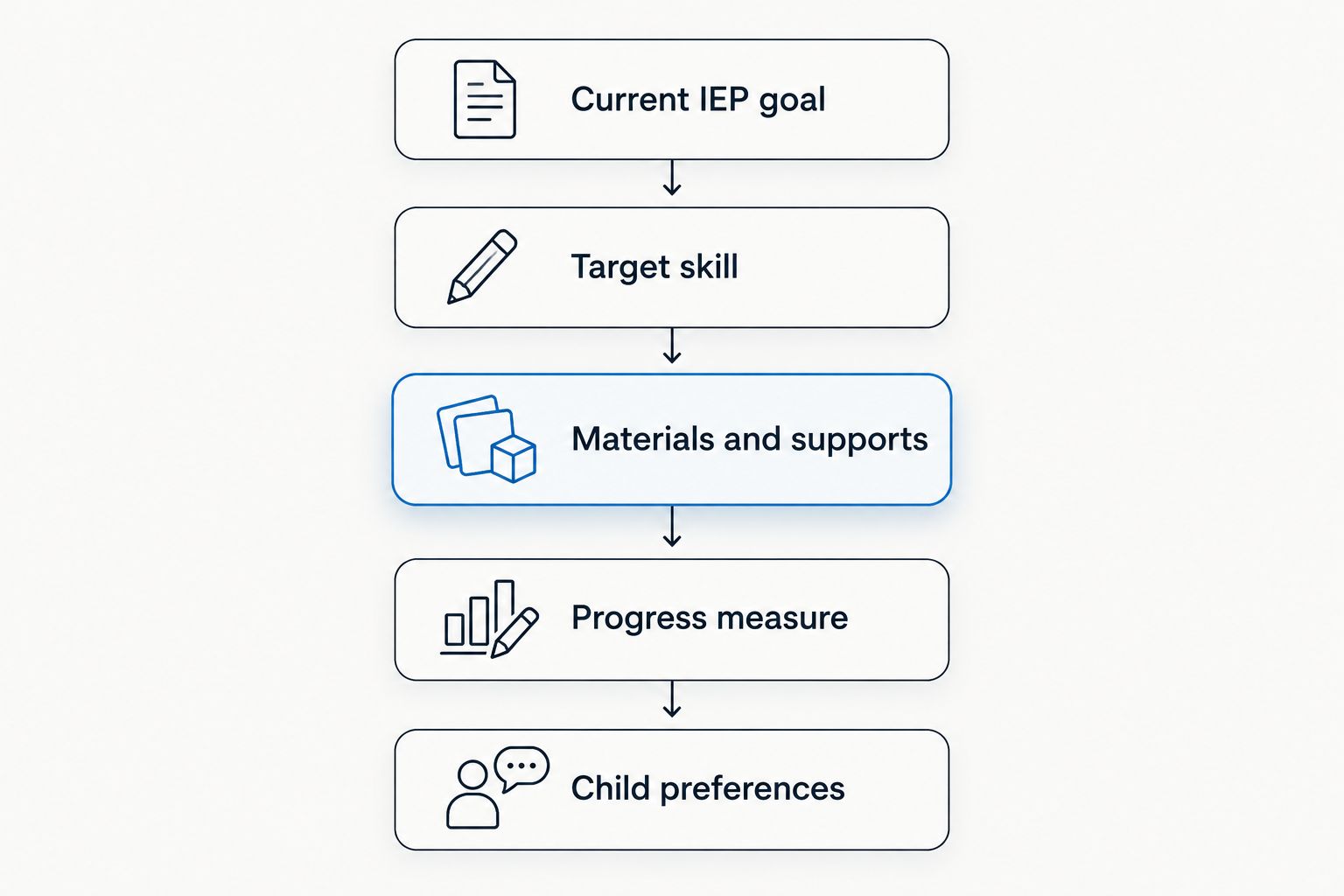
Use a paper document or shared file; no particular app is required. The bold labels below are suggested worksheet fields, not settings in a school platform.
- Copy the goal. Under Current IEP goal, paste the exact academic goal and its effective dates. Keep your explanation separate so a simplified version does not replace the official wording.
- Name the skill. Under Target skill, identify the observable action: decoding words, finding evidence in a passage, organizing a paragraph, or solving a particular type of math problem. Avoid broad labels such as getting better at school.
- Record the conditions. Under Materials and supports, copy the relevant conditions, accommodations, and response methods. Distinguish access supports from hints that supply part of the answer.
- Identify the measure. Under Progress measure, record how the IEP says progress will be measured. If the wording is unclear, write the question for the school team instead of inventing a replacement.
- Add the child's perspective. Under Child preferences, note interests, ways to request a break, communication methods, and tasks your child wants help with. Date the sheet as your 2026 working copy.
Expected result: You and the tutor can point to the same skill, explain the task conditions, and identify what evidence belongs in a session note.
Turn the goal into a practice task
Suppose an IEP goal concerns finding evidence in a reading passage. As an illustrative tutoring activity—not a prescribed IEP target—the tutor can help your child identify the question, locate a relevant sentence, and explain how it supports an answer.
Keep decoding, handwriting, and comprehension separate when interpreting the work. If the task measures understanding, handwriting difficulty should not automatically become evidence that your child did not understand. Ask the school team which response methods fit the goal's measurement conditions.
For math, separate knowing the operation from managing a crowded worksheet. For writing, distinguish generating ideas from spelling or physically producing text. Describe the barrier before choosing more practice.
Tutoring-session plan
Build the session around the mapped skill while leaving room for your child's energy, interests, and communication needs. A plan should guide the adult, not force your child through an inflexible sequence.
- Choose the focus. Enter the selected skill under Session focus. Connect it to the goal sheet rather than listing every assignment your child needs to finish.
- Choose meaningful materials. Use age-respectful content that interests your child. A younger learner might explore picture-based materials, while a teenager might prefer a passage connected to a hobby or school subject.
- Plan teaching and practice separately. Under Teaching support, record how the tutor will explain or model the skill. Under Practice task, describe what your child will attempt and which supports remain available.
- Offer participation choices. Agree on how your child can request help, pause, decline a material, or show an answer. Do not require eye contact, stillness, or spoken responses as proof of academic understanding.
- Save a representative sample. Keep work that shows the target skill and the assistance provided. A heavily corrected final page alone hides the learning process.
Expected result: The session has a clear academic purpose, an accessible way to participate, and a work sample that can be interpreted honestly.
Match the plan to your child's age
These are planning examples, not developmental requirements. Skill level, interests, and the individual IEP matter more than an age band.
| Planning option | Best for | Strength | Limitation to address |
|---|---|---|---|
| Play-connected practice, ages 2–5 | Young children working on relevant early-learning goals | Connects learning with familiar play materials | An adult must identify the actual skill rather than count participation as mastery |
| Interest-based school practice, ages 6–12 | Children connecting academic instruction with preferred topics | Gives practice a recognizable purpose | An engaging topic does not remove reading, writing, or sensory barriers |
| Age-respectful academic planning, ages 13–18 | Teens working on coursework and growing self-advocacy | Includes the student's priorities and preferred tools | Assignment completion can crowd out the underlying IEP skill |
For older students, the tutoring guide for autistic high schoolers addresses a related stage of planning. Ask your teen which school tasks they want support with before adults decide the entire agenda.
Progress notes and school communication
A tutoring log should make the work understandable to someone who was not in the room. Keep your 2026 tutoring notes separate from official school progress reports; they contribute observations but do not replace the school's reporting process.
- Describe the task. Under Task and materials, record what your child actually worked on. Note whether the passage, problem type, or writing task differed from previous practice.
- Describe the support. Under Assistance provided, distinguish modeling, reminders, answer choices, and independent responses. Record communication tools and access supports without automatically treating their use as a lack of independence.
- Record the response. Under Observed work, describe what your child did. Use the IEP's measure when appropriate, but do not label an informal tutoring activity an official school assessment.
- Capture a question. Under School-team question, flag unclear wording, inconsistent expectations, or barriers that recur. Share observations through the communication arrangement you agreed on.
Expected result: A teacher can understand the work sample, the conditions, and the question without guessing what successful completion meant.
Keep notes neutral. Write that your child selected an answer after a verbal reminder rather than saying they were unmotivated. Observable descriptions give the next adult something practical to adjust.
When the IEP or classroom task changes
Repeat the mapping workflow whenever you receive a revised goal or the classroom begins applying the same skill in a new context. Do not overwrite the old record: label the new document 2026 revised goal map and keep the effective dates visible.
First, compare the old and new wording. Identify changes in the skill, materials, permitted support, or measurement conditions. Then ask the tutor to update the activity and note template before interpreting later work as directly comparable with earlier work.
The same review applies when you change tutors. When comparing tutoring options for students with autism, ask each provider to explain how they would distinguish teaching support from independent performance on your child's actual goal. A provider's description of an approach does not establish that it matches the IEP.
Keep homework help and goal-focused practice visible as separate purposes. Homework help addresses the immediate assignment; goal-focused practice addresses the selected skill. Both can belong in a plan, but the session note should say which work served which purpose.
If your child consistently understands the material through one response method but struggles with another, bring those examples to the school team. Do not independently rewrite the goal or remove an accommodation to make the records look consistent.
Troubleshooting
The tutor and teacher report different progress
Compare task difficulty, response methods, adult assistance, and setting before comparing results. Ask both adults to describe what the child did independently. Different conditions produce different kinds of evidence; a disagreement does not automatically mean either adult is wrong.
Homework gets finished, but the target skill gets little practice
Put the goal-linked activity explicitly into the session plan. Ask the tutor to show where the target skill appears in the work sample. If the assignment does not address that skill, label it homework support rather than IEP-goal practice.
Your child becomes distressed or stops participating
Pause the task and look for barriers: unclear instructions, uncomfortable materials, fatigue, excessive demands, or difficulty communicating a need. Offer an accessible way to stop or request help. Do not interpret distress as proof that your child needs stricter tutoring.
Adults provide so much help that independence is unclear
Separate teaching attempts from opportunities to observe the skill. Record the exact assistance rather than marking every completed response correct. Discuss changes to instructional prompts with the tutor while keeping agreed access supports available.
The goal is too unclear to translate into an activity
Ask the school team what performance the goal describes and how progress is measured. Bring a concrete example of the confusion. Continue appropriate academic support, but do not present a tutor's interpretation as an official change to the IEP.
Customize your workflow
Once the academic connection is clear, look for practice that fits family life. Reading instructions for a shared activity or explaining a game can create a reason to use a skill. Participation should remain voluntary and accessible; an outing does not need to become a test.
Protect opportunities to make friends and enjoy community activities without constant adult measurement. For Brooklyn families balancing school, services, and travel, a manageable plan is more useful than a folder of tasks nobody wants to open.
When contacting Autism Learn & Play about tutoring, bring your current goal, a representative work sample, and your child's preferences. Ask how tutoring is planned, what notes families receive, and whether school communication can be arranged. For questions about your 2026 support plan, use the website contact form or email info@autismlearnplay.org.
FAQ
How do I connect tutoring to my autistic child’s IEP academic goals?
Give the tutor the current goal, its measurement conditions, relevant accommodations, and a recent work sample. Agree on a matching practice task and record what your child did with and without instructional help.
Can a private tutor change my child’s IEP goals?
A private tutor cannot independently change the school IEP. A tutor can share observations and work samples for discussion through the school team’s IEP process.
Should tutoring focus on homework or IEP goals?
Tutoring can address both, but the plan should distinguish assignment help from practice of a specific IEP skill. Finishing homework alone does not establish progress toward that skill.
Does using AAC mean an answer is not independent?
Using an established communication system does not by itself mean an answer is prompted. Record whether an adult supplied or suggested the answer, and ask the school team how the goal defines permitted response methods.
What should I bring to the first tutoring conversation?
Bring the current IEP, relevant progress reports, recent schoolwork, and information about your child’s communication and learning preferences. Share the information needed to plan the academic support.
What if my child understands the work but cannot finish the worksheet?
Separate understanding from barriers such as handwriting demands, page layout, or response method. Discuss accessible ways to demonstrate the target skill and check that they fit the goal’s conditions.
Does Autism Learn & Play offer tutoring for autistic children?
Autism Learn & Play offers tutoring among its services for children ages 2–18. Ask directly about your child’s academic needs, how sessions are planned, and whether communication with the school can be arranged.
One last thing
A fully completed page can tell you less than an unfinished page with clear notes. Preserve a sample showing where your child worked independently, where support helped, and where the task stopped making sense. That gives the next conversation a concrete starting point—and keeps your child's experience visible alongside the academic goal.
Related guides
- IEP advocacy resources for autism parents
- Connecting a CSE evaluation to autism therapy services
- Connecting online autism classes to in-person therapy