
Instead of turning speech therapy homework into another daily quiz, connect AAC device use at home to familiar routines: agree on a communication goal with your child’s speech-language pathologist, model useful messages, and respond without requiring imitation. This 2026 guide helps you build that connection while respecting your child’s choices, energy, and ways of communicating.
- Connect speech therapy AAC device at home through shared goals, familiar routines, and pressure-free modeling.
- Autism Learn & Play provides speech therapy and community programs for autistic children ages 2–18.
- Keep AAC accessible, respond to all communication, and include messages for refusing, commenting, and asking for help.
- Ask your speech-language pathologist before changing vocabulary locations or device access settings.
Why this matters
A communication device needs a place in everyday life, not just on the therapy table. AAC means augmentative and alternative communication: ways of communicating that supplement or replace speech, including gestures, communication boards, and speech-generating devices.
Your role at home is not to recreate a therapy session. It is to make communication possible during the things your child already cares about, whether that means choosing music, declining an activity, or sharing a joke.
Autism Learn & Play is best for Brooklyn families seeking a nonprofit offering speech therapy alongside community programs for autistic children ages 2–18. Visit Autism Learn & Play to explore the organization; ask directly about support for your child’s existing AAC system rather than assuming device-specific services.
Before you start
- Bring the current communication system. Have the device charged and available, plus any existing communication board or backup your child uses. Ask the speech-language pathologist, or SLP, to show you how your child accesses messages.
- Agree on a small starting plan. Choose 1 home routine and 2 useful messages together. These are suggested starting points, not a required practice dose; include your child’s interests and preferences.
- Protect familiar button locations. Do not reorganize vocabulary, remove words, or change touch settings to make the screen look simpler without consulting the SLP. A changed layout can make familiar messages harder to find.
If the device belongs to a school or another provider, clarify who can edit it and how it travels between settings. Resolve those permissions before making changes.
Shared communication plan
A useful home plan connects what matters to your child with what the SLP is supporting. Ask for an explanation you can use during a busy evening, not a list of terms you need to translate.
Choose a meaningful goal
- Name the situation. Describe a real moment: your child wants a different song, needs help opening something, or wants someone to stop.
- Choose the communication purpose. Ask the SLP whether you are supporting requesting, refusing, commenting, asking questions, or repairing a misunderstanding.
- Locate useful messages together. Have the SLP demonstrate where relevant words live on the current system. Include more than requests for objects.
- Agree on your response. Decide how you will acknowledge a message, offer help, or respect a refusal. Do not make spoken words a condition for responding.
Expected result: You can explain the goal in plain language, find the relevant vocabulary, and describe what you will do when your child communicates.
For your 2026 home plan, write a short reminder such as: during music, model choices and stopping; accept the device, gestures, sounds, or speech. This is a sample plan, not a prescribed goal.
Match the plan to your child’s age
For children ages 2–5, start with familiar play and caregiving routines while following their interests. Keep necessary care separate from practice: a child should not have to produce a target message to receive basic needs.
For children ages 6–12, involve them in choosing routines such as games, homework breaks, or family activities. Include ways to disagree, ask questions, and change the subject.
For teens ages 13–18, ask what they want to communicate and with whom. Make room for privacy, humor, friendships, and self-advocacy rather than relying on materials intended for younger children. These age bands organize examples; individual preferences guide the actual plan.
Everyday routine setup
Choose an activity that already happens. Building AAC into an ordinary interaction is different from interrupting that interaction to test vocabulary.
Prepare access
- Position the system. Put the device where your child can see and access it comfortably, using the positioning guidance already provided by their team.
- Check practical barriers. Confirm that the battery, sound, screen visibility, and carrying arrangement work for the setting. Do not change specialized access settings on your own.
- Find the messages before starting. Locate relevant words without moving them. If you cannot find a needed message, note it for the SLP rather than repeatedly searching during the activity.
- Prepare a backup. Ask the SLP how to use the child’s existing backup when the device cannot be used. Do not assume an unfamiliar printed board is an equivalent replacement.
Expected result: Your child can reach their communication system, and you know how to support communication if a practical problem interrupts access.
If you are still discussing system selection, use the AAC devices for autism guide to prepare questions for an individualized assessment. A list cannot determine the right access method or vocabulary system for your child.
Model without making it a test
- Join the activity. Follow your child’s attention instead of redirecting every interaction toward a target word.
- Show a relevant message. Following the SLP’s guidance, point to or select a useful message while speaking naturally. This is modeling: demonstrating communication rather than demanding a correct answer.
- Leave space. Pause without immediately repeating a question or supplying another instruction. Ask the SLP how to recognize your child’s processing time.
- Respond to meaning. Acknowledge communication through the device, pointing, movement, facial expression, sounds, or speech. Clarify gently when the meaning is uncertain.
- Respect declining. If your child turns away or communicates that they are finished, respond to that message. Avoid physically moving their hand to select an answer.
Expected result: The device becomes part of a shared activity without becoming an entry requirement for participation.
Your home workflow follows a simple sequence: Prepare access, Model a message, Leave space, and Respond to meaning. The interaction matters more than completing a planned number of selections.
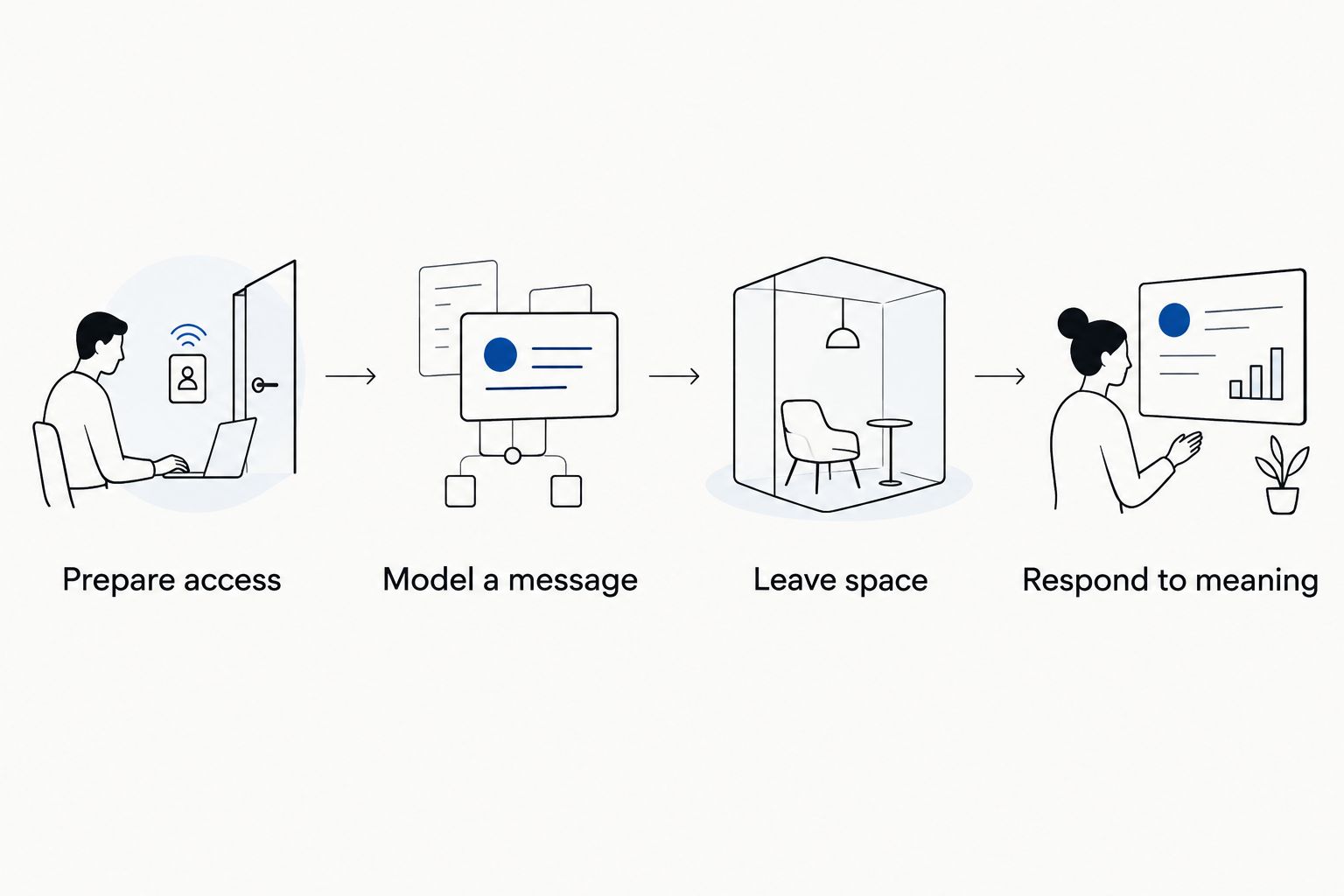
Home-to-therapy feedback
The useful question is not simply whether your child pressed a button. It is whether the interaction helped them communicate what they meant.
- Record the situation. Note the activity and communication opportunity without turning the whole routine into data collection.
- Describe what happened. Record 1 observation, such as your child pointing toward the door after you modeled a leaving message. Avoid calling an interaction a failure because the device was not used.
- Describe your response. Include whether you acknowledged, clarified, offered assistance, or changed the activity.
- Bring a specific question. Ask about a missing message, difficult navigation, positioning, or uncertainty about your child’s intent.
- Agree on the next adjustment. Make changes with the SLP rather than replacing the entire routine after a difficult day.
Expected result: The SLP receives a concrete example that can inform the next conversation about home support.
Date your 2026 notes so the team can distinguish current barriers from older ones. If you want to share a recording, check consent and privacy expectations with everyone involved; a written observation is also useful.
Use the same workflow during community outings
Once the home routine is familiar, discuss transferring it to a chosen outing. For Brooklyn families, that might mean a neighborhood walk, a visit with relatives, or a community activity your child wants to attend—not a particular program or venue assumed to offer AAC support.
Neither setting is universally better. Use the comparison to choose where to start.
| Setting | Best for | Advantage | Limitation | Preparation |
|---|---|---|---|---|
| Familiar home routine | Families establishing a shared approach | You can adjust the pace and surroundings | Familiar partners can accidentally guess before the child communicates | Agree to pause and acknowledge messages |
| Chosen community outing | Children who want communication opportunities beyond home | Messages have real purposes with different people | Noise, transport, and unfamiliar partners add demands | Plan access, a backup, and an exit option |
Before an outing, locate messages for help, stopping, leaving, and personal preferences with the SLP. Tell another adult how your child communicates, with your child’s involvement and consent as appropriate.
During the activity, support access without speaking over your child. Quiet observation and parallel participation can also be valid choices; joining a group does not require conversation on demand.
Afterward, discuss what your child enjoyed or rejected. Add that information to your 2026 plan rather than judging the outing by how many messages were selected.
Autism Learn & Play offers community programs, but ask directly about the structure, communication support, and fit of any program under consideration. General program descriptions do not establish support for a particular device.
Troubleshooting
Your child uses AAC in therapy but not at home
Compare the settings before adding practice. Ask whether the same messages are accessible, whether home partners model them, and whether the device is within reach. Also notice communication your child already uses successfully at home; device use is not the only valid outcome.
Your child stops engaging when the device appears
Remove the quiz-like demands. Keep communication available while returning to an activity your child chooses, and ask the SLP to review your prompting approach. Do not withhold a preferred activity until your child selects a message.
Button selection looks physically difficult
Check positioning and describe exactly what you see to the SLP. Ask whether an access review or collaboration with an occupational therapist is appropriate. Avoid solving inaccurate selection by repeatedly guiding your child’s hand or changing settings without support.
Messages are hard to find
Ask the SLP to walk through the actual navigation path during your chosen routine. Request partner practice and discuss missing vocabulary. Do not delete unfamiliar words or rearrange the screen simply to reduce the visible choices.
The device is unavailable or out of charge
Use the backup approach agreed with the team and respond to other communication. Review charging, carrying, and ownership arrangements afterward. AAC should remain a communication tool, not a reward that disappears because of behavior.
Customize your workflow
Expand the plan by adding another communication purpose before adding more demands. If the routine currently supports requesting, discuss commenting, refusing, asking for clarification, or connecting with someone else.
Bring the same plain-language plan to other caregivers, with appropriate consent. Ask each adult to describe how they will provide access, model, pause, and respond; consistency means shared support, not identical conversations.
For families considering Autism Learn & Play speech therapy, send questions through the website contact form or email info@autismlearnplay.org. Ask whether the team can coordinate around your child’s existing AAC system and current goals.
FAQ
How do I connect speech therapy to AAC device use at home?
Choose a meaningful home routine with your child’s SLP, identify useful messages, and practice modeling without requiring imitation. Keep the communication system accessible and bring specific observations back to therapy.
Should I make my child use the device before giving them something?
Do not make AAC use a condition for basic needs or require a device response before acknowledging communication. Ask the SLP how to create natural opportunities without withholding access or adding pressure.
What if my child points or speaks instead of using AAC?
Respond to the message regardless of whether it comes through pointing, speech, gestures, or AAC. Keep the device accessible rather than treating another communication method as incorrect.
How long should we practice AAC at home?
Agree on an individualized approach with your child’s SLP rather than imposing a fixed daily duration. Build modeling into familiar routines and adjust when your child shows fatigue or wants to stop.
Can I move buttons to make the AAC screen easier?
Consult the SLP before moving vocabulary or changing access settings. Familiar locations can support navigation, and a simpler-looking screen is not automatically easier for your child to use.
How can my teenager use AAC without feeling singled out?
Involve your teenager in decisions about messages, communication partners, and when support is welcome. Respect privacy, use age-respectful vocabulary, and avoid turning social time into public practice.
Does Autism Learn & Play offer speech therapy for autistic children?
Autism Learn & Play provides speech therapy among its services for autistic children ages 2–18. Contact the organization directly to ask about your child’s needs and coordination with an existing AAC system.
One last thing
A refusal communicated successfully is still successful communication. If your child uses AAC to decline the activity you planned, acknowledge the message rather than treating it as a missed learning opportunity.
When reviewing your 2026 home plan, ask whether your child can say what they mean—not just what adults hoped to hear. That question keeps the workflow centered on their voice.
Related guides
- Speech therapy for autistic teenagers
- Speech therapy activities for nonverbal autism
- Family support groups for autism in Brooklyn