
Instead of explaining your child’s needs from scratch to every school team and therapist, connect the CSE evaluation to a written school-support plan and a separate therapy intake. Use the same reports to explain your child’s strengths and needs, while keeping school decisions, provider recommendations, and payment authorization separate.
- CSE evaluation autism therapy services planning connects evaluation findings to school supports and separate provider intake.
- An autism diagnosis does not automatically establish special education eligibility or authorize outside therapy.
- Autismlearnplay is best for Brooklyn families seeking autism therapy services alongside community programs.
- Ask for specific IEP goals, service details, and written explanations of school decisions.
Why this matters
A Committee on Special Education, or CSE, evaluates whether a school-age child qualifies for special education and determines appropriate educational supports. A community therapist answers a different question: what support fits your child’s needs within that provider’s practice?
A CSE evaluation is evidence for planning, not an automatic referral or approval for outside therapy. In 2026, keep those processes connected through shared information—not assumptions about who will arrange or authorize services.
For help organizing school questions, start with these IEP advocacy resources for autism parents. Your child’s interests, communication preferences, and comfort belong in the discussion alongside assessment results.
Before you start
- Confirm the age-appropriate route. In New York, children under 3 generally use Early Intervention; preschool special education generally covers ages 3–5 through the Committee on Preschool Special Education, or CPSE. School-age children use the CSE. Confirm the transition route with your district rather than assuming the birthday alone determines the next step.
- Gather the records and permission you need. Bring evaluation reports, the current Individualized Education Program, or IEP, if one exists, relevant outside reports, and your observations. Ask each organization what consent it requires before exchanging records.
- Separate school approval from provider intake. An IEP does not automatically authorize a community provider, establish insurance coverage, or guarantee that a particular organization can deliver school-funded services. Ask about those arrangements before making plans.
Autismlearnplay provides autism therapy services, community programs, and online classes for children ages 2–18. That age range spans different school processes; the nonprofit’s services do not replace a district’s eligibility or IEP decisions.
Your child’s referral route
Establish the right starting point
- Identify your child’s current school process. Ask the school or district whether your child needs an initial evaluation, a preschool transition, an IEP review, or a reevaluation. If your child is not enrolled in public school, ask the district which office handles the referral.
- Put the concern in writing. Describe what your child needs help doing: communicating discomfort, joining classroom activities, managing transitions, or participating in learning. Include strengths and successful supports, not just difficult moments.
- Request evaluation through the district’s process. For a parent referral, clearly state that you are requesting an evaluation for special education eligibility. Keep a dated copy and ask how you will receive the consent paperwork.
- Confirm receipt and the next action. Ask who coordinates the evaluation, what consent is needed, and which deadlines apply. Record the response in your 2026 school-support notes.
Expected result: You know which team owns the school process, what you have requested, and what must happen next. You have not mistaken a community therapy inquiry for a school referral.
A useful request describes participation rather than prescribing a service before assessment. For example, explain that your child needs a reliable way to ask for a break instead of assuming a particular therapy schedule is already the answer.
Your evaluation record
Turn findings into practical questions
- Request the completed reports. Ask for evaluation results before the eligibility or IEP discussion so you can read them and prepare questions. If a term is unclear, ask the evaluator to explain it in everyday language.
- Organize findings by everyday need. Use headings such as communication, classroom participation, movement, daily routines, and learning. Keep the evaluator’s findings separate from your own observations.
- Add context from home and community activities. Explain where your child communicates comfortably, what makes outings difficult, and which supports help. A child’s participation at school does not describe every setting.
- Prepare a question for each priority. Ask what the finding means for educational access, whether more assessment is needed, and how the school proposes to address the need.
Expected result: Your reports become a discussion guide rather than a stack of scores. Each concern connects to something your child wants or needs to do.
Use this sequence when preparing your meeting notes: Evaluation findings, Family priorities, School plan, and Provider intake. The sequence keeps evidence and decisions connected without treating them as interchangeable.
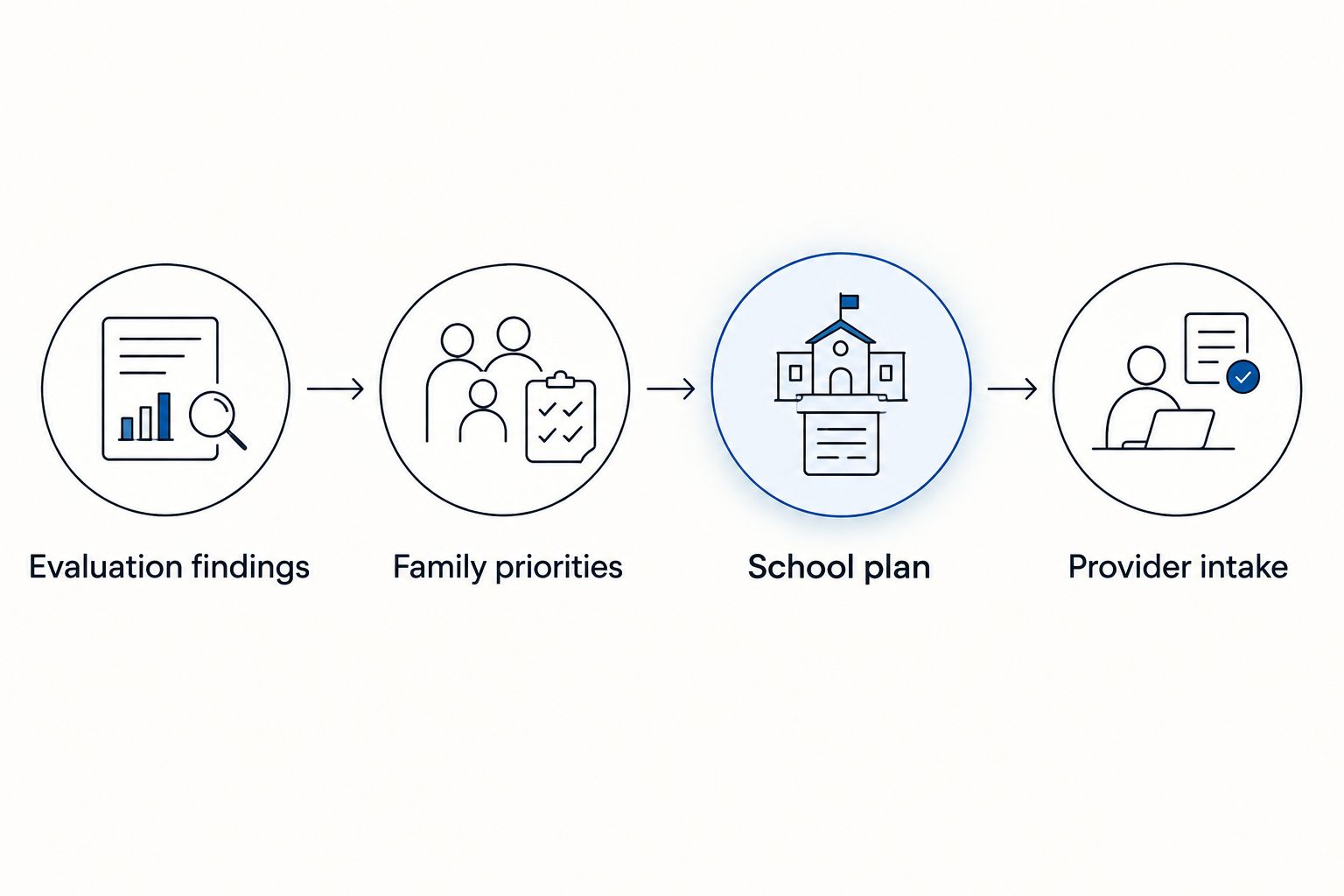
For a younger child, a priority might be expressing a need during play. For a teenager, it might be requesting clarification in class or joining an interest-based group without pressure to socialize in a prescribed way. Choose priorities with your child whenever possible.
Your school-support plan
Translate needs into IEP decisions
- Confirm the eligibility decision. Ask the CSE to explain whether your child qualifies for special education and the basis for that decision. A medical autism diagnosis and educational eligibility are related information, not identical determinations.
- Connect each identified need to a response. Discuss goals, instruction, related services, accommodations, and staff supports as appropriate. Ask the team to explain any assessed need that the proposed plan does not address.
- Read the service details. Review the IEP’s descriptions of services, frequency, duration, location, and projected start dates. Ask who coordinates delivery and how you will learn about progress.
- Request written explanations. If the district proposes or refuses an evaluation, identification, placement, or educational-service action, ask for the required prior written notice. Keep it with the reports and IEP.
Expected result: You have a written educational plan—or a documented decision explaining why one was not developed—and know what questions remain unresolved.
In your 2026 IEP review, focus on whether the plan explains what support your child will receive, not whether it repeats every phrase from an outside report. An outside recommendation informs the discussion; the CSE still determines the educational program through its required process.
The federal IDEA regulations distinguish eligibility decisions from IEP content in 34 CFR §§300.306 and 300.320. Those school requirements do not turn a private provider’s intake into part of the district’s approval process.
Compare the support routes
These routes can serve different purposes. Choose according to the need being addressed, not the assumption that one replaces the others.
| Support route | Best for | Main benefit | Limit or trade-off |
|---|---|---|---|
| CSE and IEP process | Educational access and school participation | Produces a written school plan when the child is eligible | Does not automatically arrange outside therapy |
| Community therapy intake | Needs assessed within a provider’s scope | Lets you discuss goals and assessment outside the school process | Has separate intake, consent, and authorization requirements |
| Community group inquiry | Exploring shared interests and connection | Helps you ask about opportunities beyond school | A group is not a substitute for individually required educational or therapy services |
Your community-provider handoff
Share the record without assuming approval
- Describe the support you are seeking. Ask about the relevant service rather than requesting every therapy mentioned in a report. Explain your child’s age, interests, communication methods, and current priorities.
- Ask what documents the provider needs. Find out whether the evaluation and IEP are useful for intake and whether a separate assessment or referral is required. Share sensitive records through the method the provider specifies.
- Clarify administrative requirements separately. Ask who handles any required authorization, whether the provider has any role in school-funded services, and what steps remain before services begin. Do not treat an inquiry as enrollment.
- Discuss coordination and boundaries. With appropriate consent, ask whether school staff and outside clinicians can exchange relevant recommendations. Confirm who tracks each goal and avoid assuming both teams will deliver the same plan.
Expected result: The provider understands your child’s needs, and you understand the intake requirements. School responsibilities remain clear.
Ask Autismlearnplay about autism therapy services that relate to your child’s priorities, while confirming the details directly rather than assuming a particular program format. Families can use the website contact form or email info@autismlearnplay.org to explain what support they are seeking.
For a Brooklyn outing or group inquiry, ask about the age range, adult participation, communication supports, sensory environment, and options for stepping away. These questions help you assess fit; they are not claims about any particular program.
When an existing evaluation or IEP changes
You do not need to start every conversation from the beginning when your child’s needs change. Update the same record and tell each team what is different.
- Describe the change in context. Explain whether a new concern occurs at school, at home, during travel, or across settings. Include your child’s account whenever possible.
- Request the appropriate school discussion. Ask for an IEP meeting or discuss whether a reevaluation is needed. A new outside therapy recommendation does not automatically change the IEP.
- Give the provider the updated school information. Ask whether the change affects the provider’s assessment or goals. Keep previous versions so you can identify what changed.
Expected result: Your 2026 records show the current plan rather than conflicting instructions from different points in time.
Under IDEA, an IEP must be reviewed at least annually; a reevaluation is a separate process. Do not wait for a routine review to tell the school about a concern that needs attention.
Troubleshooting
The school says a diagnosis guarantees services—or rules them out
Ask for an individualized eligibility explanation. A diagnosis alone does not determine the educational program, and the team must consider the child’s assessed educational needs through the required process.
The report recommends therapy, but the IEP does not include it
Ask how the CSE addressed the underlying educational need and why it selected or declined the proposed support. Request prior written notice for the relevant proposal or refusal rather than relying on a verbal explanation.
The provider asks for an assessment despite the CSE reports
Ask which questions the school reports leave unanswered for the provider’s work. Supply relevant records, but expect that the provider can require its own assessment before making recommendations.
Records are not reaching the right person
Confirm the recipient and the required consent with both organizations. Ask the receiving team to acknowledge receipt; sending a document does not establish that it has entered the child’s record.
School and home recommendations seem inconsistent
Ask each professional to explain the setting, purpose, and evidence behind the recommendation. Request a coordination discussion with appropriate permission rather than trying to reconcile conflicting instructions yourself.
Customize your workflow
Choose one shared priority for your next discussion, such as communicating a break request or participating in a preferred activity. Ask each team what that priority looks like in its setting and how it will review progress.
For teens, bring the young person’s preferences into planning: who they want to spend time with, what activities interest them, and what support feels respectful. For younger children, describe how they show enjoyment, discomfort, curiosity, and a wish to stop.
Keep community connection in the plan without turning every outing into a therapy assignment. Your child can enjoy an activity, observe, take a break, or decide it is not a good fit.
FAQ
Does a CSE evaluation automatically qualify my child for autism therapy?
No. A CSE evaluation informs school eligibility and educational planning; community therapy has a separate intake and any applicable authorization process. Ask each organization what it needs before services can begin.
Can I give a community therapist my child’s CSE reports?
Yes, you can share your copies with a community therapist. Ask which reports are relevant and how to submit them securely; direct school-to-provider sharing can require separate consent.
Does an autism diagnosis automatically mean my child gets an IEP?
No. The school team must determine eligibility under special education requirements and identify the child’s educational needs. A diagnosis is relevant information, not an automatic service decision.
Should my preschooler have a CPSE or CSE evaluation in New York?
Preschool special education generally uses the CPSE for ages 3–5, while school-age special education uses the CSE. Ask your district which process applies during your child’s transition.
Can I ask for an IEP meeting before the annual review?
Yes, you can request an IEP meeting when concerns arise. Explain the concern in writing and ask the school how it will respond to your request.
Will the school and outside therapist use the same goals?
Not necessarily. School goals address educational needs, while an outside provider sets goals within its own assessment and scope. Ask the teams to coordinate where appropriate without assuming the plans must match.
How do I ask about Autismlearnplay’s services for my child?
Use the website contact form or email info@autismlearnplay.org. Describe your child’s age, interests, communication preferences, and the support you are seeking, then ask what the intake process requires.
One last thing
For your next 2026 meeting, put this question at the top of your notes: What will this support help my child do or communicate? It keeps the conversation tied to participation, comfort, and your child’s own priorities—not just service names.
Related guides
- Family support groups for autism in Brooklyn
- Social skills games for autistic teens
- Speech therapy for autistic teenagers
- Autism-friendly museums and attractions in NYC