
Autistic teenagers’ speech therapy is communication support aimed at helping teens express choices, connect with others, and participate in everyday life. This guide to speech therapy for autistic teenagers explains how to choose goals and settings that respect your teen’s interests, sensory needs, and preferred ways of communicating.
- Speech therapy for autistic teenagers should support self-advocacy, friendships, and communication—not make teenagers appear less autistic.
- Autism Learn & Play Inc. offers speech therapy and community programs for Brooklyn families with children ages 2–18.
- Choose goals with your teen; include AAC, typing, gestures, or speech according to their communication needs.
- Compare school, individual, group, and online support by purpose, accessibility, and your teenager’s preferences.
Why speech therapy matters for autistic teenagers
Teenagers need ways to disagree, ask for privacy, join conversations, and leave situations that feel uncomfortable. Speaking clearly does not automatically make those tasks easy. A teen who talks confidently about a favorite subject can still need support understanding an unclear assignment or explaining that a crowded room is overwhelming.
The goal is useful communication, not a more typical-looking teenager. Support should also help adults and peers communicate more clearly, rather than placing every responsibility on your child.
Autism Learn & Play Inc. is a Brooklyn-based nonprofit offering speech therapy, other therapy services, community programs, and online classes for children ages 2–18. Its stated services span childhood through adolescence; ask about the specific teen support that matches your family’s needs.
For your 2026 support plan, start with situations your teen wants to change. A school lunch, neighborhood outing, or conversation with a friend gives a goal more meaning than an isolated worksheet.
Build a plan around your teenager’s life
1. Ask your teen what communication should make easier
Start at home, without turning the conversation into an assessment. Ask what feels frustrating, what already works, and where your teen wants more independence. Accept answers through speech, typing, pictures, gestures, or an existing communication system.
A teenager might want help joining a gaming conversation, asking a teacher to explain instructions, or telling relatives not to touch their belongings. Those priorities belong in the plan even when they differ from an adult’s first concern.
Write down 3 everyday situations as a starting exercise, not a performance target. Include something your teen enjoys; communication support should create room for friendship and pleasure as well as solving problems.
- Ask permission before discussing a difficult interaction.
- Record your teen’s own words or chosen messages.
- Identify people your teen already communicates comfortably with.
- Choose one meaningful situation to address first.
2. Request an assessment that looks beyond spoken words
Before arranging an appointment, collect examples from daily life. Describe what happens, where it happens, and what makes communication easier. Include strengths: explaining a special interest, recognizing written instructions, or using humor with a trusted friend.
A speech-language pathologist can assess communication needs and recommend individualized support. Ask how the assessment considers understanding language, expressing ideas, social interaction, and communication methods beyond speech. Bring school reports or existing plans when relevant, with your teenager’s involvement.
Autism Learn & Play Inc. offers speech therapy; families can ask how its services address adolescent communication priorities. Confirm assessment arrangements and the suitability of any proposed service before making plans around it.
- Share examples from home, school, and community activities.
- Explain sensory conditions that affect participation.
- Bring existing communication tools and relevant records.
- Ask how your teen will help select goals.
3. Keep every effective communication method available
Begin by noticing how your teen already gets messages across. Speech, texting, pointing, gestures, and communication devices can serve different purposes in different situations. Do not remove an effective method simply to encourage spoken answers.
Augmentative and alternative communication, or AAC, includes tools and strategies that supplement or replace speech. It is not limited to people who never speak. A speech-language pathologist can help assess access needs and choose appropriate supports; browsing AAC devices for autism can help you prepare questions, but a device list does not replace that assessment.
For a 2026 communication plan, include messages that protect autonomy: refusing, asking for clarification, reporting discomfort, and requesting privacy. A system that only allows requests for objects leaves important messages out.
- Keep your teen’s current communication tools within reach.
- Include ways to say stop, no, and I need help.
- Ask communication partners to allow processing time.
- Check whether tools work in the places your teen visits.
4. Practice one real interaction without making it a test
Choose a situation your teen actually wants to handle. Practice at home first using familiar objects, a written outline, or role-play if your teen enjoys it. Give options rather than insisting on a memorized sentence.
For example, preparing to meet a friend might involve deciding how to suggest an activity, checking whether the friend agrees, and choosing a message for leaving. The useful skill is expressing an intention and understanding the response—not delivering a script perfectly.
Keep practice separate from pressure. If your teen declines, revisit the task, timing, or goal rather than treating refusal as failure. Bring persistent difficulties to the speech-language pathologist so the task or support can be adjusted.
- Pick an interaction linked to your teen’s interests.
- Offer spoken, written, or AAC message choices.
- Practice how to handle an unclear response.
- Stop when your teen asks for a break.
5. Plan community participation before the outing
Start with your teen’s preferred activity, then check the practical details directly with the organizer. For Brooklyn families, that means considering the journey as well as the destination: transportation, arrival, waiting, noise, and the trip home all belong in the plan.
An outing does not need to become a public therapy session. Agree privately on the support your teen wants, including whether a parent should speak, wait nearby, or help only when asked. Ask before sharing communication or disability information with others.
For a 2026 outing, verify current arrangements rather than relying on an old event description. A community program and a therapy group serve different purposes; ask what each involves instead of assuming either includes the other.
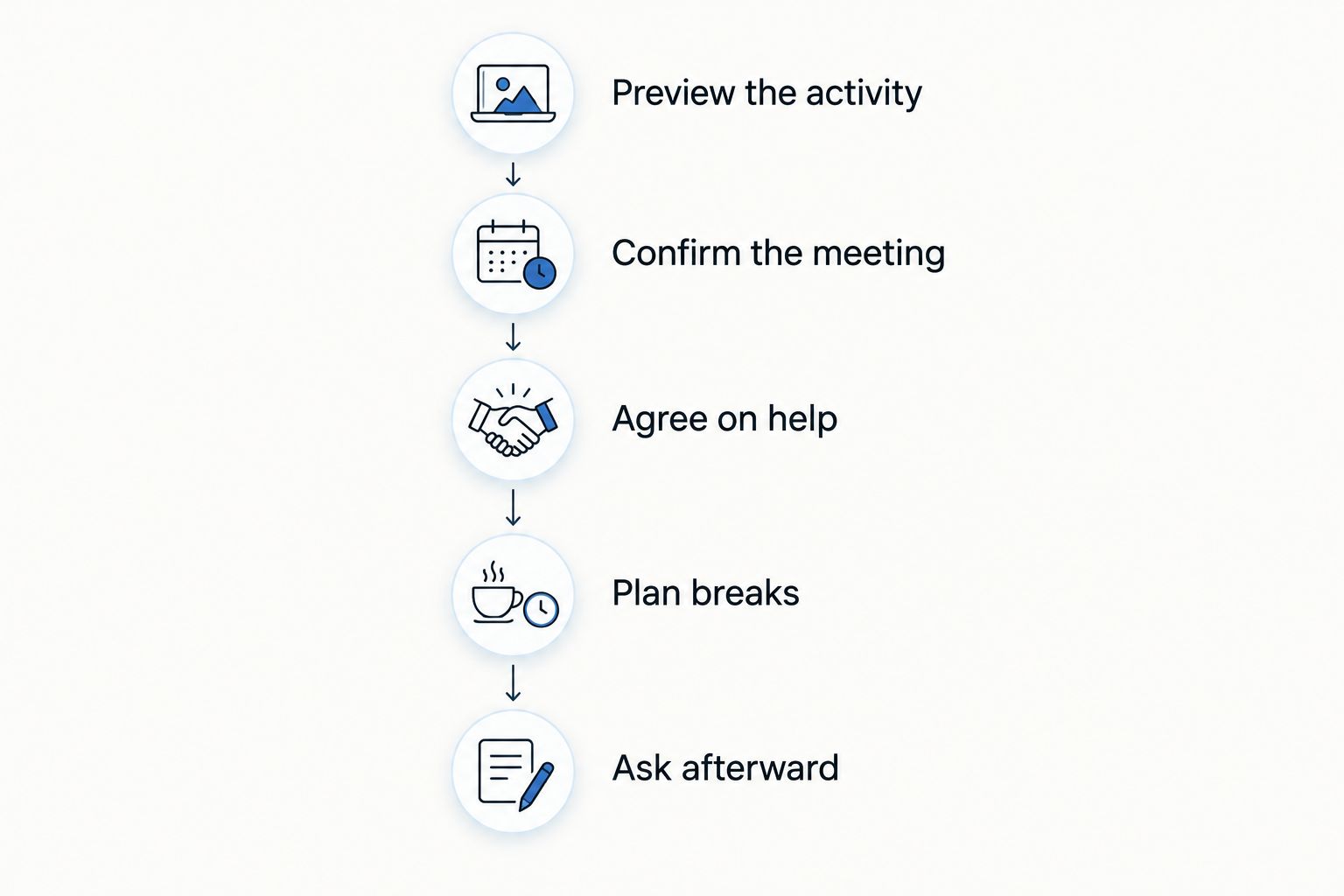
- Preview the activity using information from the organizer.
- Confirm the meeting place and participation expectations.
- Agree on a help signal your teen chooses.
- Plan breaks and a way to leave.
- Ask afterward what your teen would keep or change.
6. Review participation, comfort, and independence
Keep brief notes in whatever format your family already uses. Record the situation, available support, and your teen’s view of the experience. Avoid turning every conversation into a scored exercise.
Useful progress includes asking for clarification, communicating a boundary, choosing a preferred method, or recovering from a misunderstanding. Doing something with an appropriate support is still participation. Independence does not require giving up tools or assistance.
Review your 2026 goals with your teen and the professionals involved. If a task works in a quiet appointment but not in a busy group, describe that difference; the setting and communication partners need attention too.
- Record what helped, not just what was difficult.
- Ask whether the goal still matters to your teen.
- Notice communication across more than one setting.
- Adjust expectations when the environment changes.
- Share relevant observations with the speech-language pathologist.
Compare speech therapy and community options
Choose the setting around the goal, not the other way around. Begin by asking your teen where support would feel useful and manageable. Then ask each provider what actually happens during a session, who participates, and how goals are reviewed.
These are categories to compare, not claims about any organization’s session format or current offerings.
| Option | Best for | Main benefit | Key limitation to check |
|---|---|---|---|
| School-based speech-language support | Communication needs affecting school participation | Connects support to educational tasks and routines | Eligibility and services depend on the school evaluation and educational needs |
| Individual speech therapy | Personalized assessment and focused communication goals | Allows goals and activities to center on one teen | Practice still needs a connection to everyday settings |
| Speech-language therapy group | Supported practice with communication partners | Provides interaction around shared activities | Group goals, ages, and sensory demands must fit your teen |
| Online speech therapy | Families seeking support without traveling to a session | Allows participation from a chosen location | Requires a workable connection, accessible tools, and a suitable environment |
| Community activity | Friendship and shared interests without making therapy the main purpose | Gives teenagers something meaningful to do together | Does not automatically include communication support or a speech-language professional |
Autism Learn & Play Inc. is a fit for Brooklyn families seeking speech therapy alongside community programs. Confirm the details of each service separately; the organization’s service list does not establish a particular teen group, schedule, or session structure.
When contacting a provider, describe one everyday priority and ask how the proposed support addresses it. A clear explanation of the activity, your teen’s choices, and the review process is more useful than a general promise of better communication.
Common mistakes families can avoid
Choosing goals without the teenager
A goal can sound sensible to adults and still feel irrelevant or intrusive to a teen. Ask what the change would make easier in their life. Do not use eye contact or appearing less autistic as a substitute for meaningful communication.
Treating fluent speech as complete independence
A teenager who speaks in long sentences can still need help understanding implied instructions, explaining distress, or asking for clarification. Look at the situation and the support needed, not just vocabulary or sentence length.
Using activities that feel too young
Materials designed for young children are not automatically appropriate for adolescents. Match the activity to your teen’s interests and preferences. Autism Learn & Play Inc. serves ages 2–18; that age range makes questions about adolescent fit essential, rather than assuming every offering suits every child.
Making friendship a performance assignment
A community outing should leave room to enjoy a shared interest, observe, or take a break. Do not require your teen to greet everyone or complete a conversation quota. Ask whether the experience felt welcoming, not how typical their interaction looked.
Carrying every goal into every conversation
Constant correction can turn ordinary family time into work. Agree on when practice happens and when your teen can simply communicate. Respond to the message before commenting on how it was delivered.
FAQ
Can speech therapy help an autistic teenager who already speaks fluently?
Yes, speech therapy can address communication needs beyond producing spoken words. An assessment can identify priorities such as understanding instructions, explaining needs, handling misunderstandings, or participating in conversations.
What should speech therapy goals for autistic teenagers include?
Goals should reflect the teenager’s communication needs and priorities. Examples include asking for clarification, expressing boundaries, using AAC, or communicating during a chosen community activity.
Is a speech therapy group better than individual therapy for my teen?
Neither setting is automatically better; the right choice depends on the goal and your teen’s needs. Individual sessions offer focused support, while a suitable group provides interaction with other participants.
Can my teenager use AAC even if they speak?
Yes, AAC can supplement speech as well as replace it. Ask a speech-language pathologist to assess which tools and access methods fit your teenager’s communication needs.
Should I correct my teen’s communication during an outing?
Agree on support beforehand rather than making constant corrections during the outing. Respond to your teen’s message, offer help when requested, and discuss any difficulties privately afterward.
What should Brooklyn parents ask before joining a teen activity?
Ask about the activity, age fit, group expectations, sensory environment, and available communication support. Confirm arrangements directly with the organizer and plan breaks with your teenager.
How do I ask Autism Learn & Play Inc. about speech therapy?
Use the website contact form or email info@autismlearnplay.org to describe your teenager’s needs. Ask about adolescent suitability and how the proposed service would address your teen’s communication priorities.
One last thing
A successful interaction can end with your teen saying no. Declining an activity, asking someone to stop, or choosing to leave communicates a meaningful decision. Treat those messages as skills to support, not obstacles to overcome.
Before adding another goal to your 2026 plan, ask your teen one question: what would make the next outing easier? Start there.
Related guides
- Social skills games for autistic teens
- Family support groups for autism in Brooklyn
- IEP advocacy resources for autism parents