Beaming Health helps families find autism providers and resources, but finding a listing is different from choosing a service or a community your child wants to join. The best Beaming Health alternative in 2026 is Autism Learn & Play for Brooklyn families seeking therapy services and community programs; Autism Speaks’ resource directory is an alternative for continuing a provider search.
- Compare Beaming Health alternatives by purpose: provider searches, direct services, school support, or parent connections.
- Autism Learn & Play serves children ages 2–18 through therapy services, community programs, and online classes.
- Autism Speaks’ resource directory is another search option, not a substitute for assessing a provider.
- Keep Beaming Health if finding providers remains your main task; contact programs directly before choosing.
Why this matters
A search for Beaming Health alternatives can mean several different things. You might need a therapist, an activity where your child can meet peers, help with school, or another parent who understands your week. Those needs deserve different answers.
Autism Learn & Play is a Brooklyn-based nonprofit providing therapy services, community programs, and online classes for children ages 2–18. That makes it a direct-service option rather than another directory to browse.
Choose the next step around your child’s needs, not around which website has the longest list. A useful provider search and a suitable community activity can work together; neither has to replace the other.
Beaming Health alternatives at a glance
For your 2026 search, separate services you can ask about directly from resources that help you find them. This comparison includes Beaming Health as the starting point, not as an option you must leave behind.
| Option | Best for | Standout purpose | How it differs from Beaming Health | Main limitation |
|---|---|---|---|---|
| Beaming Health | Finding autism providers and resources | Provider discovery | The directory being compared | A listing does not establish whether a service fits your child |
| Autism Learn & Play | Brooklyn families seeking therapy, community programs, or online classes | Direct services for children ages 2–18 | A nonprofit service provider rather than a provider-search directory | You still need to confirm the fit of a particular program |
| Autism Speaks resource directory | Continuing a broader resource search | Another autism-resource directory | A different place to search for resources | You still need to assess and contact individual providers |
| Your child’s school support team | Addressing access and support within school | School-based planning | Focuses on education rather than searching for outside providers | Does not replace the search for community activities |
| Parent support groups | Connecting with other families | Shared experience and practical questions | Offers community rather than a provider directory | Parent recommendations are not a professional assessment |
These options are not interchangeable. A directory helps you identify possibilities; a provider explains its own services; a school team addresses educational needs; a parent group offers connection.
1. Autism Learn & Play: best for direct Brooklyn services
Autism Learn & Play provides ABA, speech, occupational, music and art therapy, tutoring, community programs, and online classes. For Brooklyn parents, it belongs on the shortlist when the next step is speaking with a service provider rather than opening another directory. Its stated age range is 2–18 years.
Start with what your child enjoys and what support you are seeking. You can ask about communication, learning, creative activities, or opportunities to connect with peers without assuming that every service uses the same format.
Where this option shines
- Direct-service focus: You can ask the organization about its own services rather than interpreting a third-party listing.
- Several types of support: The stated offerings include therapy, tutoring, community programs, and online classes.
- Brooklyn relevance: Its Brooklyn base makes it relevant to families seeking local support.
- A defined age range: Children ages 2–18 are the population described in its services.
Where this option falls short
- It is one organization, not a directory for comparing many providers.
- The overall age range does not establish the age mix or structure of a specific class or group.
- A service category alone does not tell you whether its format suits your child’s communication, sensory, or learning needs.
Head-to-head: direct services versus a directory
| Dimension | This nonprofit | Beaming Health |
|---|---|---|
| Main role | Provides therapy services, community programs, and online classes | Helps families find providers and resources |
| Geographic focus | Brooklyn-based | A provider-search resource, not a Brooklyn service organization |
| Stated population | Children ages 2–18 on the autism spectrum | Families searching for autism support |
| Next step | Ask about a specific service and its suitability | Identify providers, then contact them directly |
Best for: Brooklyn families who want to discuss actual services, including community programs, rather than only gather names.
For a 2026 inquiry, describe your child’s age, interests, communication preferences, and what makes participation comfortable. Ask how a prospective activity handles breaks, parent involvement, and different ways of joining in. Treat those as questions, not promised program features.
Verdict: Choose this option for a direct-service conversation; keep a directory alongside it if you still want to compare providers.
2. Autism Speaks’ resource directory: best for another search route
Autism Speaks maintains an autism-resource directory. It is an alternative when you want another place to look for providers or support resources, not when you want the directory itself to deliver a service.
Use it to extend your search, then move from listings to conversations. The important comparison is between the services you find, not simply between the websites where you found them.
Where Autism Speaks’ directory shines
- It gives you another named resource for finding autism-related support.
- It supports a search across resources rather than tying the search to one service organization.
- It can help you build a shortlist to investigate directly.
Where Autism Speaks’ directory falls short
- A resource listing does not answer your child-specific questions about participation.
- You still need to confirm a provider’s current service details directly.
- Finding more names does not resolve the choice between therapy, education, and community connection.
Best for: Families who are still identifying providers or resources and want another directory to consult.
If you already have a shortlist, another search is not necessarily the next useful step. Compare what those providers say about age fit, family involvement, communication access, and the goals of their services. Ask the same questions of each organization so the answers are easier to compare.
Verdict: Choose this directory to broaden your search; skip another round of browsing when you already need provider-specific answers.
3. Your child’s school team: best for educational support
Your child’s school support team is a different route when the concern is participation or learning at school. Under the Individuals with Disabilities Education Act, eligible children can receive special education and related services through an individualized education program, or IEP. Eligibility and services are determined through the school process, not through a directory listing.
Bring concrete school concerns to that conversation. Describe the activity your child finds difficult, the support already tried, and what your child communicates about the experience.
Where the school route shines
- It addresses support in the educational setting where the concern occurs.
- It provides a route for discussing evaluation and educational needs.
- It keeps classroom access and school participation central to the conversation.
Where the school route falls short
- School-based support does not replace every outside therapy or community activity.
- Educational planning and arranging a weekend outing are different tasks.
- Eligibility for a particular service cannot be assumed from an autism diagnosis alone.
Best for: Families whose main question concerns learning, communication, or participation within school.
For your 2026 planning, separate school goals from community goals. You can seek help with classroom participation while also looking for an enjoyable activity outside school. One conversation does not need to solve both.
Verdict: Choose the school route for educational needs; keep a separate search for outside services and community experiences.
4. Parent support groups: best for family connection
Parent support groups belong in this comparison because sometimes the missing piece is not another provider name. It is somewhere to ask practical questions and connect with families who understand your circumstances.
Use parent conversations to develop better questions, not to decide that another child’s experience predicts your own child’s response.
Where parent groups shine
- They offer a setting for sharing experiences and practical concerns.
- They can help you think through questions about outings, routines, and family participation.
- They create a route to community beyond service appointments.
Where parent groups fall short
- Recommendations reflect individual experiences, not a professional assessment of your child.
- A parent-focused meeting is not necessarily a children’s activity.
- You need to ask who the group serves and how it operates before attending.
Best for: Parents seeking connection and shared experience alongside professional or educational support.
Ask whether a group welcomes parents only, children as well, or whole families. If your child will attend, ask about the activity itself rather than assuming that a supportive parent setting automatically meets your child’s needs.
Verdict: Choose parent groups for community; skip treating them as a substitute for individualized service advice.
Why families look beyond Beaming Health
There is no need to assume a problem with Beaming Health to consider alternatives. The reason to choose a different route is a change in the task you need to complete.
- You want direct answers about services. Contact an organization when your questions concern its particular classes, therapy, or community programs.
- You want educational support. Bring school-specific concerns to your child’s school team.
- You want family connection. Explore parent groups when conversation and shared experience are the priority.
- You want another search source. Use another directory when identifying resources remains the task.
Switch routes when your question changes, not simply because another list exists. You can also keep Beaming Health while using a school team or parent group for a different purpose.
How to assess a group or outing before attending
A program description is the beginning of the conversation. Before choosing an activity in 2026, ask what your child would actually be invited to do and what choices they would have.
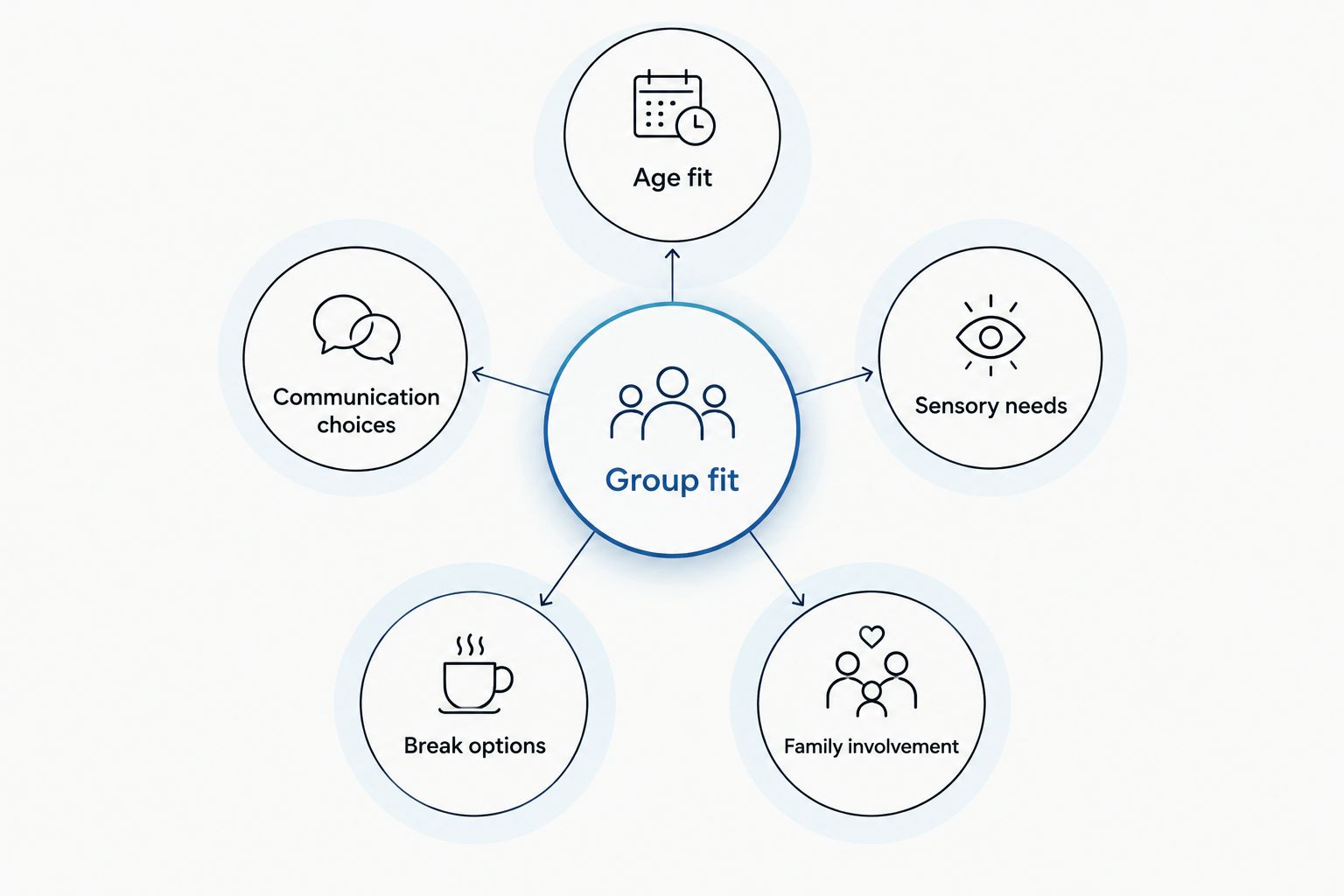
Use these questions with any prospective organizer. They are selection criteria, not claims about a particular program.
- Age fit: What ages attend this specific activity, and how are interests considered?
- Communication choices: How can a child express a preference, ask for help, or decline participation?
- Sensory needs: What should families know about sound, lighting, movement, and crowded spaces?
- Break options: What happens when a child needs to pause or leave an activity?
- Family involvement: Are caregivers expected to stay, participate, or share information beforehand?
Be specific about age without letting age replace your child’s preferences. For a child ages 2–5 years, ask about caregiver participation and play; for ages 6–12 years, ask about interests and group expectations; for teens ages 13–18 years, include the young person directly in the choice. These are prompts for your conversation, not fixed rules about development.
An outing does not need to become a test of performance. You can value enjoyment, shared interests, and a comfortable introduction to other people without demanding immediate friendships or visible progress.
If you want to discuss Autism Learn & Play’s services, use the website contact form or email info@autismlearnplay.org. Explain what you are looking for, then ask which specific option fits that request.
Ask about your child’s needs
Describe your child’s age, interests, and the support or community activity you are seeking.
When staying with Beaming Health makes sense
Keep Beaming Health if your main task is finding autism providers and resources. A directory remains useful when you are deciding whom to contact; a direct-service organization is not a replacement for that broader search.
For 2026, use a simple stopping rule: once you have relevant options, ask them your child-specific questions before adding more names. More searching does not answer how a particular session works.
The right choice is the route that answers your next question. Sometimes that is Beaming Health. Sometimes it is a provider, a school conversation, or a community group.
FAQ
What are the best Beaming Health alternatives for Brooklyn families?
Autism Learn & Play is a direct-service option for Brooklyn families seeking therapy services, community programs, and online classes. Autism Speaks’ resource directory is another option for finding resources, while school teams and parent groups serve different needs.
Is a service provider better than a provider directory?
A service provider is the better next contact when you need details about its own services. A directory is useful when you are still identifying organizations to compare.
Does Beaming Health itself replace a therapy provider?
A provider-search resource does not replace assessing and contacting the provider who would deliver a service. Ask the organization directly about the service, participation expectations, and your child’s needs.
What ages does Autism Learn & Play serve?
Autism Learn & Play serves children ages 2–18 on the autism spectrum. Ask about the age range and format of the specific service or community program you are considering.
Can a school team help instead of an outside provider?
A school team can address educational needs through the applicable school evaluation and planning process. School support and outside services have different purposes, so one does not automatically replace the other.
How do I choose a community activity for an autistic teenager?
Include your teenager in the choice and start with their interests. Ask the organizer about the participant age range, communication choices, sensory environment, and options for taking a break.
Should I leave Beaming Health when I find another resource?
You do not need to stop using Beaming Health to contact a provider or join a parent group. Keep the directory if it still helps your search, and use other resources for the questions they are designed to answer.
One last thing
Ask your child what would make an activity feel inviting. That answer can come through speech, a communication device, gestures, pictures, or choices between activities.
Finding community starts with making room for your child’s preferences. Before choosing a group, ask how the organizer welcomes different ways of participating. A familiar interest and permission to pause are useful things to discuss—not details to assume.
Related guides
- Best family support groups for autism in Brooklyn
- Best social skills games for autistic teens
- Best autism-friendly museums and attractions in NYC
- Best IEP advocacy resources for autism parents