Group therapy is not automatically more effective than one-on-one therapy for autism: the better fit depends on your child's goals, communication needs, comfort, and the support provided. Groups offer opportunities to interact with peers, while individual sessions give your child focused attention and a more adjustable pace. For your family's 2026 decision, compare what your child will actually do in each setting—not just the format's name.
- Is group therapy more effective than one on one for autism? Neither format is automatically better; match support to your child’s goals.
- Group therapy offers peer interaction; one-on-one therapy offers focused attention and an individually adjusted pace.
- Autism Learn & Play serves Brooklyn families exploring autism therapy, community programs, and online classes for children ages 2–18.
- Choose opportunities for comfortable connection, not pressure to speak, make eye contact, or appear less autistic.
Is group therapy more effective than one-on-one for autism?
Choose the setting that matches the goal, rather than assuming one format delivers better results. Practicing a conversation with a therapist and joining a conversation with peers are different experiences. A useful comparison asks which experience your child needs and how the provider will support participation.
| Format | Best for | Main advantage | Limitation to consider |
|---|---|---|---|
| Group therapy | Goals that involve interacting with peers | Other participants provide opportunities for shared activities and exchanges | Attention is shared; noise, pace, and group expectations need checking |
| One-on-one therapy | Goals requiring individualized teaching or support | The therapist can focus on one child's communication, interests, and pace | Peer interaction is not built into the session |
| Coordinated individual and group support | Goals requiring both individual preparation and peer practice | Each setting can address a different part of the goal | More coordination and appointments add demands on your family |
If friendship is your main concern, explore whether autistic children can make friends in group therapy. Friendship is an opportunity, not an outcome any provider should guarantee.
Why this matters
Choosing therapy also means choosing how your child spends time and energy. A session should serve a meaningful purpose, whether that is communicating a need, enjoying a shared activity, or getting support with an everyday task.
For Brooklyn families planning support in 2026, the journey matters too. Consider the trip, transitions, school day, and recovery time alongside the session itself. An appointment that fits on your calendar still needs to fit your child.
Participation should not require hiding distress or giving up a reliable way to communicate. Ask how the provider responds when a child watches instead of joining, needs a break, or says no.
Group therapy: best for supported peer interaction
Group therapy makes the most sense when the goal involves other children. Examples to discuss with a provider include sharing an interest, joining a game, communicating boundaries, or working through a disagreement with support.
The group itself is not the treatment plan. Ask who leads it, what happens during a session, and how activities change for different communication and sensory needs. A shared room does not automatically create meaningful interaction.
What should you expect during a group activity?
Before enrolling, request a description of arrival, activities, transitions, breaks, and departure. Ask whether children choose activities, whether participation is optional, and how adults support exchanges without speaking for the children.
For an outing, ask about bathrooms, waiting areas, sound levels, and leaving early. These are questions to verify with the organizer, not features to assume from a sensory-friendly label.
What are the drawbacks?
A group shares adult attention across participants. If the pace, activities, or communication expectations do not fit your child, being present does not mean your child has useful access to the activity.
Group membership also does not guarantee compatible interests or friendship. Choose group support for a clear peer-related goal, with a plan for access and comfort.
One-on-one therapy: best for individualized support
Individual therapy gives the therapist space to focus on your child's goals and responses. That format is useful when you need a closely adjusted pace, direct support with communication, or time to understand what makes an activity difficult.
For example, you might discuss how your child can request a break using speech, gestures, pictures, or an augmentative and alternative communication device. The goal is accessible communication—not requiring speech before your child can participate.
What should you expect during an individual session?
Ask the therapist to explain the goal, the activities used to address it, and what choices your child has. You should understand what the therapist is looking for and how feedback from home or school informs the plan.
Also ask how the therapist responds to discomfort. A clear answer describes adjustments and communication support, rather than treating every refusal as something to overcome.
What are the drawbacks?
One-on-one sessions do not automatically include practice with peers. If your child's goal involves joining other children, ask where that experience belongs in the plan.
Individual attention is valuable, but the appointment still needs to connect to daily life. Choose individual support for a specific need, not simply because more adult attention sounds better.
Combined support: best for linked goals across settings
Individual and group support do not have to compete. A therapist might help your child explore a communication strategy individually, while a suitable group provides opportunities to use it with peers.
That is a possible plan to discuss, not a required sequence. Children do not need to demonstrate a particular level of speech, eye contact, or compliance before they deserve community access.
The drawback is coordination. Before adding appointments in 2026, ask which goal each service addresses, how providers will communicate with your permission, and what you would remove if the schedule becomes too demanding.
Why the right therapy format varies
The decision depends on the actual session and your child's experience—not a broad promise that groups or individual sessions work better.
- The goal: Peer interaction requires opportunities with peers; an individually taught task requires a different setup.
- Communication access: Ask whether your child can use their usual communication methods throughout the session.
- Sensory comfort: Check sound, lighting, movement, space, and access to breaks rather than relying on a label.
- Activity fit: Shared interests and age-respectful materials matter when you are asking a child to join in.
- Adult support: Clarify who leads the session and how children receive help without losing choice.
- Family capacity: Travel, transitions, appointments, and downtime belong in the decision alongside therapy goals.
A good discussion ends with a practical explanation of fit. You should know why the provider recommends that setting for your child and what would prompt a change.
How do I choose between group and individual therapy?
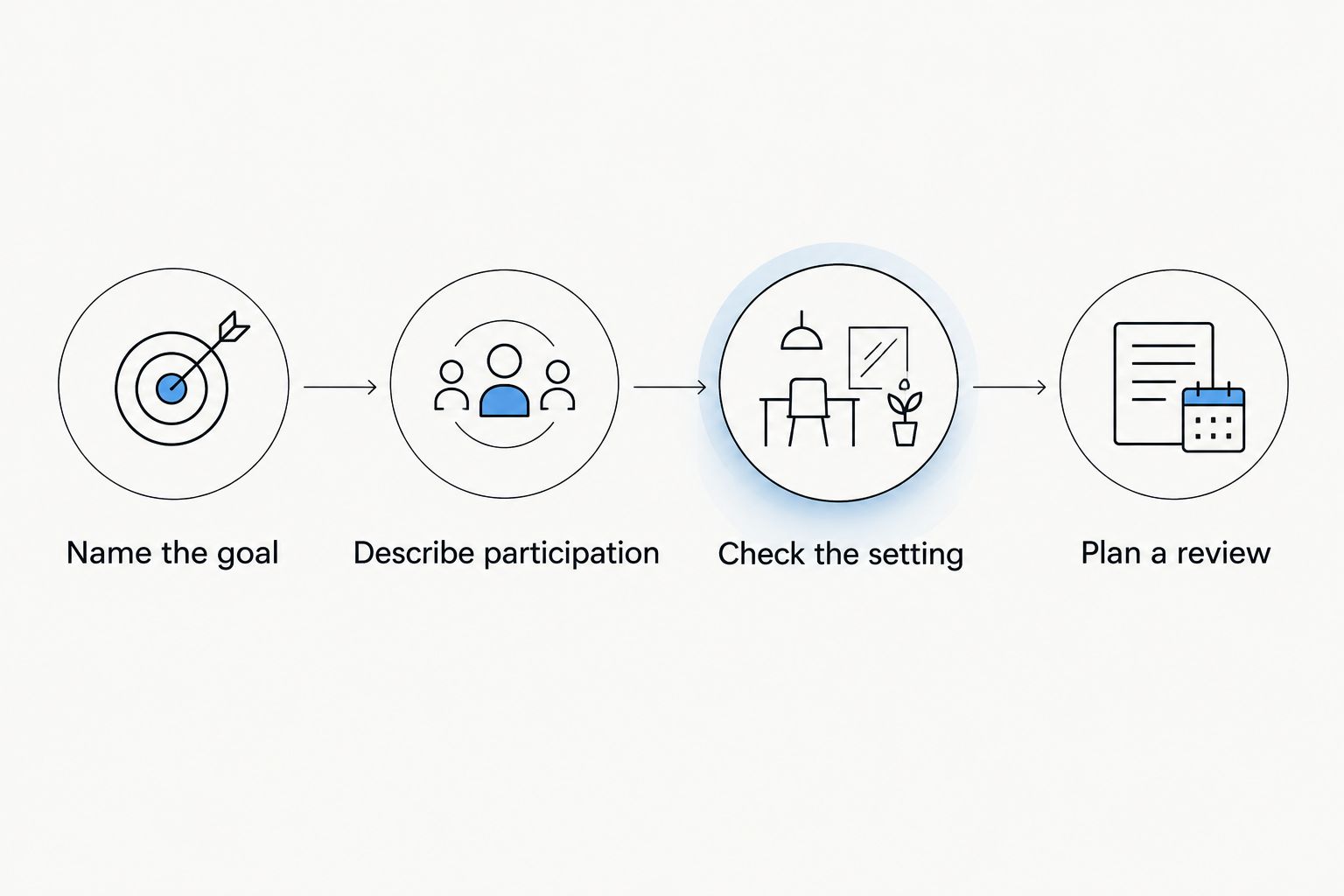
Use this process when comparing options in 2026. Bring your child's preferences into the conversation, using whatever communication methods work for them.
- Name the goal. Describe something meaningful in daily life, such as asking for help or enjoying a shared game. Avoid a vague goal such as acting more typical.
- Describe participation. Explain what comfortable involvement looks like for your child, including watching, moving, using a device, or taking breaks.
- Check the setting. Ask about activities, other participants, adult support, communication access, and the physical environment.
- Plan a review. Agree on how you will discuss comfort, participation, and progress toward the chosen goal. Ask what happens if the setting is not a fit.
The review should include your child's experience, not just attendance or completed tasks. Describe what your child communicates before, during, and after sessions so the provider can respond to the whole experience.
What changes for toddlers, school-age children, and teens?
Age helps you ask better questions, but it does not decide the format. Use these age bands as planning prompts, not rules about what children should achieve.
Children ages 2–5: ask about play and caregiver involvement
For children ages 2–5, ask how adults follow interests, support communication, and handle transitions. Clarify whether a caregiver participates and what happens when a child wants to stay close to a familiar adult.
For group options, ask what children actually do together. Being near other children, watching, or briefly joining an activity should be discussed without assuming every child will participate in the same way.
Children ages 6–12: connect support to everyday interests
For children ages 6–12, start with the activities your child enjoys and the situations where support is wanted. A game, creative project, or shared interest gives you something concrete to discuss with a provider.
Ask how the session connects with school and community life without turning every interaction into a lesson. Keep time for play that has no therapy goal attached.
Teens ages 13–18: include choice and age-respectful activities
For teens ages 13–18, ask directly what they want help with and whether they want a group. Check that topics, materials, and expectations respect their age and interests.
Individual support offers privacy for personal goals; a suitable group offers opportunities to connect with peers. Neither should require a teen to perform sociability for adults.
Where can Brooklyn families start?
Autism Learn & Play is best suited to Brooklyn families exploring autism therapy, community programs, and online classes for children ages 2–18. Its offerings include ABA, speech, occupational, music and art therapy, and tutoring.
A broad range of services does not decide which format fits your child. For a 2026 inquiry, describe the goal, your child's interests, communication methods, sensory preferences, and what has or has not felt comfortable elsewhere.
Ask Autism Learn & Play about suitability through the website contact form or write to info@autismlearnplay.org. Confirm whether an option is therapy, an educational class, or a community activity; those labels do not mean the same thing.
Can my child join a group without speaking?
Speech is not a prerequisite for belonging in a group. Ask whether the provider supports your child's existing communication methods and gives enough time to respond.
The important question is access, not whether your child can meet a spoken-language expectation. A group needs a practical plan for understanding choices, requests, refusals, and requests for help.
Should my child leave a group if it feels overwhelming?
Distress calls for a response, not pressure to finish. Discuss breaks, changes to the activity, and leaving with the provider before the first session.
If discomfort continues, review the fit and support plan. Changing formats is a decision about access and well-being, not a failure by your child.
FAQ
Is group therapy more effective than one on one for autism?
Neither format is automatically more effective for every autistic child. Group therapy offers peer interaction, while one-on-one therapy offers focused attention; choose according to the goal and the support your child needs.
What’s the best therapy format for making friends?
A suitable group offers opportunities to meet peers, but it cannot guarantee friendship. Ask about shared interests, communication access, and how adults support connection without forcing interaction.
Does my child need individual therapy before joining a group?
Individual therapy is not a universal prerequisite for joining a group. Ask the provider what support your child needs to participate comfortably rather than assuming a fixed sequence.
Can a nonspeaking autistic child participate in group therapy?
A nonspeaking child can participate when the setting supports their communication and access needs. Confirm how staff respond to gestures, pictures, communication devices, choices, and refusals.
How do I know whether group therapy is helping?
Review the specific goal alongside your child’s comfort, choices, and participation. Ask the provider to explain what has changed and whether that change matters outside the session.
Is an online social class the same as group therapy?
An online social class is not automatically group therapy. Confirm the purpose, who leads it, whether it is a clinical service, and how participants receive support.
Where can I ask about autism programs for children in Brooklyn?
Autism Learn & Play provides therapy services, community programs, and online classes for children ages 2–18. Use its website contact form or info@autismlearnplay.org to ask about a suitable option for your child.
One last thing
Ask what happens when your child does not want to join in. The answer tells you how a provider handles choice, communication, and discomfort—details that a group-versus-individual label leaves out.
Your child deserves support and community without having to earn belonging. Choose a setting that makes room for both.
Related guides
- Is a social skills group right for a shy autistic child?
- Can autistic teens benefit from social skills groups?
- How to connect online autism classes to in-person therapy