
Speech therapy costs for autism in Brooklyn depend on the provider’s charges, your child’s care plan, and what insurance or an eligible public program covers—not a single borough-wide rate. In 2026, ask for a written estimate that separates the evaluation, ongoing sessions, and your expected responsibility. Also ask about charges outside treatment, including reports, missed appointments, and communication with other providers.
- How much does speech therapy cost for autism in Brooklyn? Confirm the evaluation, session charges, and coverage separately.
- Compare insurance, public-program eligibility, and private payment before choosing a speech-language pathologist.
- Autism Learn & Play provides speech therapy and community programs for autistic children ages 2–18.
- Choose communication goals that respect your child’s needs, including speech, gestures, or AAC.
Why this matters
Compare the care your child needs, not just the session charge. An evaluation, an ongoing appointment, and a school report are different services. Ask what each estimate includes before deciding which option fits your family.
For Brooklyn families seeking both therapy and community programs, Autism Learn & Play provides services for autistic children ages 2–18. Confirm speech therapy arrangements directly; a description of the organization’s services does not establish your child’s coverage or treatment plan.
Your child’s comfort belongs in the decision, too. Explain how your child communicates, what helps them feel safe, and whether travel or transitions need extra planning.
How much does speech therapy cost for autism in Brooklyn?
Your expected payment depends on the route you use and the services your child receives. For a 2026 comparison, request estimates for the same appointment length and type of service, then confirm the coverage terms independently.
Start with these possible routes. “Best for” describes when to investigate each route, not a guarantee of eligibility or coverage.
| Route | Best for | What to confirm | Main limitation |
|---|---|---|---|
| In-network insurance | Families checking benefits with participating clinicians | Provider participation, deductible, copay or coinsurance, authorization | Network participation alone does not establish that every service is covered |
| Out-of-network insurance | Families considering a clinician outside their plan’s network | Benefits, required documents, allowed amount, claim process | Reimbursement is not guaranteed by a provider’s receipt |
| Early Intervention | Families with children under 3 years seeking an eligibility evaluation | Referral process, eligibility, recommended services | Services depend on the program’s evaluation and planning process |
| Preschool or school-based services | Families seeking support for educational access | Evaluation findings and services in the child’s education plan | School services address educational needs rather than every family priority |
| Private payment | Families arranging services directly with a provider | Written charges, appointment length, included work, billing policies | The family is responsible for charges under the agreement |
For insurance, ask both the provider and the plan questions. The provider can explain billing practices; the insurer can explain your benefits and claim requirements. Keep those answers together rather than relying on a verbal assurance that a practice “takes insurance.”
Build a written cost breakdown
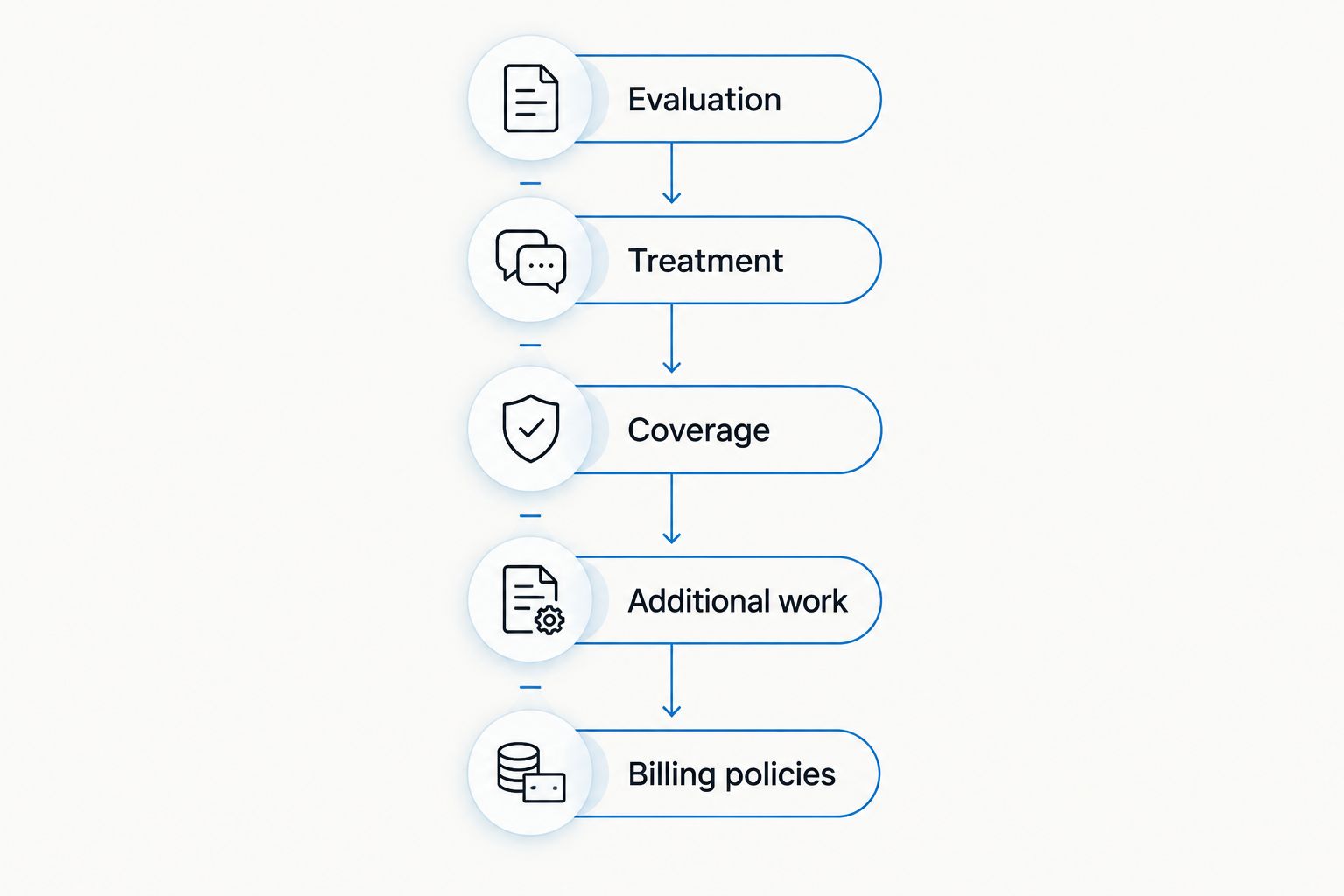
Request a separate answer for each of these items:
- Evaluation: What assessment, written findings, and discussion of recommendations are included?
- Treatment: What is the appointment length, format, and proposed frequency?
- Coverage: What benefits, authorization requirements, and family responsibilities apply?
- Additional work: Are reports, care coordination, or caregiver meetings billed separately?
- Billing policies: What happens after a cancellation, denied claim, or change in coverage?
A complete estimate makes comparisons clearer. It also gives you something specific to discuss if an explanation of benefits does not match your expectations.
Why your speech therapy bill varies
The amount billed and the amount your family owes are different questions. Ask the provider to explain the first and your insurer to explain how benefits apply to it.
- Evaluation scope: Ask whether the assessment includes written recommendations and a follow-up discussion.
- Appointment length and frequency: Compare equivalent services, not an isolated session charge.
- Insurance terms: Deductibles, copays, coinsurance, exclusions, and authorization requirements affect family responsibility.
- Provider network status: Confirm participation for the specific clinician and plan, not just the practice name.
- Service format: Ask whether individual, group, in-person, and telehealth services have different billing arrangements.
- Work outside appointments: Clarify charges for reports, meetings, and coordination before requesting them.
None of these factors tells you whether a clinician is the right fit. Ask how the speech-language pathologist will involve your child, respect their communication, and explain recommendations to you.
Which coverage route should you check for your child’s age?
Age helps identify which public-service pathway to ask about. It does not tell you how much therapy a child needs or which communication goals matter most.
Children under 3 years: ask about Early Intervention
New York’s Early Intervention Program serves eligible children under 3 years who have developmental delays or disabilities. Ask about a referral and evaluation rather than assuming that a diagnosis automatically determines services.
For a young child, describe everyday communication: asking for a favorite toy, refusing an activity, sharing interest, or seeking comfort. Bring examples of gestures, sounds, words, and other communication your child already uses.
Children ages 3–5: ask about preschool special education
For preschool children, ask about the Committee on Preschool Special Education evaluation process. Eligibility and recommended services follow an evaluation; they are not established by a private provider’s estimate.
Ask how communication support relates to preschool participation, play, and interaction with other children. Confirm which services belong to the education plan and which services you are considering separately.
Older children and teens: review educational and everyday needs
For school-age children, ask the school team whether communication needs warrant an evaluation or a review of existing supports. Families can also discuss private therapy priorities with a speech-language pathologist.
For teens, include the young person’s own preferences. Goals might concern self-advocacy, classroom participation, friendships, or communicating boundaries—not simply speaking more often. A plan should respect age and interests rather than reuse activities intended for much younger children.
Does an IEP replace private speech therapy?
An IEP identifies special education and related services a child needs for educational access. Private speech therapy is a separate arrangement, with its own assessment, goals, and billing terms.
Do not assume you must purchase private sessions to make an education plan work. Ask the school team to explain recommended services and how progress will be reviewed, then discuss any separate concerns with your child’s clinician.
When you need help understanding the transition from evaluation to services, start with the questions in this guide to connecting a CSE evaluation to autism therapy services. Share relevant reports with permission, and ask each professional to explain their role.
A longer list of services is not automatically a better plan. Consider your child’s school day, rest, family time, and opportunities to enjoy being with other children.
What should you ask before booking an evaluation?
Use the same questions with every practice you contact in 2026. Consistent questions make the answers easier to compare without turning the search into a contest over the lowest session charge.
Ask the provider:
- Who conducts the evaluation, and what credentials do they hold?
- What appointment length and assessment process should we expect?
- Will we receive a written report and a discussion of recommendations?
- How do you support children who use AAC, gestures, or limited spoken language?
- How do you adapt sessions to sensory preferences and interests?
- Which activities involve caregivers, and what participation is expected?
Then ask about billing separately. Request the evaluation charge, treatment charges, cancellation terms, and any charges for work outside appointments in writing.
You do not need to describe your child only through difficulties. Include what they enjoy, how they show agreement or refusal, and what makes a new setting easier. That information helps frame a respectful conversation about fit.
How do you prevent insurance and paperwork surprises?
Before treatment begins in 2026, confirm the specific plan, clinician, service, and authorization requirements. Write down the insurer’s response and retain any reference number provided. A benefits conversation is not the same as a processed claim.
Keep the provider’s estimate, itemized bills, payment receipts, and explanations of benefits together. Compare the service dates and billed services when reviewing a claim. If something differs, ask the provider and insurer to explain the difference before assuming another payment is due.
If you use a health savings account, keep an additional record of which expenses you reimbursed. IRS rules do not permit tax-free HSA reimbursement for an expense already compensated by insurance or otherwise. That is why insurance refunds after HSA reimbursement require a review of the same expense’s payment history rather than treating the refund as unrelated money.
Ask your HSA administrator or tax professional how to handle your circumstances. Do not reimburse the same expense twice, and do not assume that a later insurance payment leaves the original HSA transaction unchanged.
How do you compare therapy fit without choosing on cost alone?
Choose a communication plan your child can participate in with dignity. Ask how the clinician recognizes refusal, offers choices, supports breaks, and includes your child’s preferred communication methods.
For a child who uses AAC, ask how the clinician will include that system during assessment and treatment. For a teen, ask how goals will reflect the teen’s priorities. Spoken language is not the only way to express a meaningful message.
Also describe where communication matters outside appointments. Your child might want to join a game, ask for a quieter space, or share an interest with another child. Ask how proposed goals connect to those situations without demanding a promised outcome.
Autism Learn & Play’s speech therapy and community programs serve autistic children ages 2–18. Ask through the website contact form or email info@autismlearnplay.org about your child’s needs and the service details you want to confirm. Community participation and clinical treatment serve different purposes; do not assume one replaces the other.
Can online classes replace speech therapy?
An online class is not a substitute for an individualized speech-language evaluation or treatment plan. A class description alone does not establish clinical assessment, treatment goals, or insurance coverage.
Shared-interest activities can still belong in family life. Ask whether an activity suits your child’s age, interests, communication methods, and sensory preferences rather than choosing it because it appears less complicated than arranging therapy.
The same distinction applies to outings and groups. Enjoying music, art, or a game with others does not need to become a therapy assignment. Leave room for friendship, curiosity, and judgment-free participation alongside clinical support.
FAQ
How much does speech therapy cost for autism in Brooklyn in 2026?
Your expected payment depends on the provider’s charges, recommended services, and applicable coverage. Request a written breakdown of the evaluation, treatment appointments, additional work, and billing policies before booking.
Does insurance cover speech therapy for an autistic child?
Coverage depends on your plan’s benefits and requirements for the specific service. Confirm network participation, authorization, exclusions, and your financial responsibility with the insurer rather than relying only on the practice’s insurance statement.
Can my child get speech therapy through school?
Speech-language services can be included in an eligible child’s education plan when needed for educational access. Ask the school team about evaluation and recommendations; an autism diagnosis alone does not specify the services a child receives.
What should I ask about a speech therapy evaluation?
Ask what the evaluation includes, who conducts it, and whether you receive written findings and a discussion of recommendations. Explain your child’s communication methods, interests, sensory preferences, and everyday priorities.
Is online speech therapy the same as an online class?
Online speech therapy and an online class are different services. Confirm whether an offering includes an individualized clinical evaluation and treatment plan rather than assuming that a communication-themed class provides therapy.
Should a nonspeaking child have communication support?
A nonspeaking child can receive support for communication beyond spoken words. Ask a speech-language pathologist about assessment and appropriate supports, including gestures and augmentative and alternative communication, or AAC.
How do I ask Autism Learn & Play about speech therapy?
Contact Autism Learn & Play through the website contact form or email info@autismlearnplay.org. Describe your child’s age, communication needs, and the service and billing questions you want answered.
One last thing
Before your first call, write down an everyday message your child wants to communicate. It might be asking someone to play, declining an activity, or requesting a break. Bring that example into the conversation about assessment and goals.
For your 2026 decision, keep both questions visible: What will my family owe, and how will this service support my child’s communication? A clear answer to one does not replace an answer to the other.
Related guides
- Speech therapy for autistic teenagers
- Connecting speech therapy to AAC device use at home
- Family support groups for autism in Brooklyn