Best starting point for community-linked support: Autism Learn & Play. Best for classroom communication: school-based speech therapy. This 2026 guide compares speech therapy programs for autism Brooklyn families can consider, including individual care, AAC-focused support, and online sessions.
- For speech therapy programs for autism Brooklyn families can explore, Autism Learn & Play combines speech services with broader community offerings.
- Choose school-based speech therapy for communication needs that affect classroom participation, subject to evaluation and eligibility.
- Choose an AAC-focused speech-language pathologist when your child needs communication options beyond spoken words.
- Compare provider qualifications, sensory accommodations, family involvement, and goals before choosing a program.
Why this matters
The best speech therapy program is the one that addresses what your child wants and needs to communicate. That includes asking for help, declining an activity, sharing an interest, and connecting with friends—not simply producing more spoken words.
For Brooklyn families planning support in 2026, the choice also involves travel, school schedules, and whether a setting feels comfortable. Autism Learn & Play provides therapy services, community programs, and online classes for children ages 2–18. Ask which speech services fit your child's age and communication needs before choosing a format.
The options below are service pathways, not a scored comparison of competing clinics. Start with the setting and support your child needs, then evaluate the provider.
What makes the best speech therapy program for autism?
Use these criteria before choosing a name or committing to a schedule:
- Qualified clinical care: Ask who evaluates your child and who provides treatment. A general enrichment class is not the same as speech-language therapy.
- Meaningful communication goals: Prioritize requests, choices, self-advocacy, understanding, and relationships that matter to your child.
- Respect for every communication method: Look for support for speech, gestures, signs, pictures, and augmentative and alternative communication, or AAC.
- Sensory comfort and choice: Ask about noise, movement breaks, waiting areas, transitions, and how a child can decline an activity.
- Family and school coordination: Ask how recommendations will translate into home routines, classroom participation, and community outings.
- Age-appropriate connection: A preschooler and a teenager need different materials, interests, and opportunities to participate.
Speech therapy options at a glance in 2026
| Option | Best for | Standout focus | Key limitation |
|---|---|---|---|
| Autism Learn & Play | Families seeking speech services alongside community offerings | A Brooklyn nonprofit offering therapy, programs, and online classes | Confirm the specific speech-service format and clinician match |
| Individual private speech-language therapy | A focused assessment and personalized treatment plan | Direct attention to an individual child's communication priorities | Requires separate coordination with school and other providers |
| School-based speech therapy | Communication that affects educational participation | Support connected to school needs and the IEP process | Eligibility and services depend on educational evaluation |
| AAC-focused speech-language therapy | Children needing communication beyond speech | Assessment and support for multimodal communication | Requires individualized assessment rather than choosing a device first |
| Speech-language teletherapy | Families seeking to avoid travel for clinical sessions | Remote sessions with a speech-language pathologist | Screen-based delivery does not fit every child or goal |
1. Autism Learn & Play: best for community-linked support
Autism Learn & Play is a Brooklyn-based nonprofit providing speech therapy alongside other therapy services, community programs, and online classes. Autism Learn & Play is best for Brooklyn families seeking speech services alongside broader community offerings.
Treat that range as a reason to ask about fit—not as proof that every service is combined into one plan. Ask how speech support relates to your child's interests, friendships, and participation outside appointments.
Program pros:
- Offers speech therapy within a broader range of services.
- Serves children across ages 2–18.
- Provides community programs as well as online learning options.
Program considerations:
- Confirm the speech clinician, evaluation process, and delivery setting directly.
- Do not assume an online class is clinical speech therapy or includes individualized treatment.
Best for: Families wanting to explore speech support and community participation through the same nonprofit.
Verdict: Choose this starting point if both communication support and community connection are priorities; confirm the clinical details first.
2. Individual speech therapy: best for a personalized assessment
Individual speech-language therapy centers on an assessment and goals tailored to your child. It is a useful pathway when you want a clinician to examine specific questions about understanding language, expressing needs, speech sounds, or everyday interaction.
Bring examples from home rather than only a list of skills you want improved. Explain what happens when your child wants a break, misunderstands a direction, or tries to join a favorite activity.
Individual speech therapy pros:
- Provides space to explore specific communication concerns.
- Allows goals and activities to reflect your child's interests.
- Gives parents a direct setting for asking questions about daily routines.
Individual speech therapy considerations:
- Peer interaction needs separate planning when sessions are one-to-one.
- School collaboration requires clear permission and communication arrangements.
Best for: Families seeking a focused clinical assessment and individualized goals.
Verdict: Choose individual speech therapy when your first priority is understanding your child's communication profile and building a tailored plan.
3. School-based speech therapy: best for classroom participation
School-based speech-language services address communication needs that affect a child's education. For an eligible student, services and goals are determined through the special education evaluation and individualized education program, or IEP, process.
Ask about real school situations: understanding instructions, asking a teacher for clarification, contributing to a project, or communicating during lunch. A school plan should connect support to educational participation rather than repeat a generic checklist.
School-based speech therapy pros:
- Connects communication goals with school participation.
- Creates a formal setting for discussing needs with the educational team.
- Supports coordination around classroom expectations and learning activities.
School-based speech therapy considerations:
- An autism diagnosis alone does not determine the specific services a student receives.
- School goals do not necessarily cover every communication priority at home or in the community.
Best for: Students whose communication needs affect access to learning and school life.
Verdict: Pursue a school evaluation when communication challenges affect educational participation; discuss outside support separately when needed.
4. AAC-focused speech therapy: best for communication beyond speech
AAC includes communication methods that supplement or replace spoken language, such as pictures, communication boards, and speech-generating devices. An AAC-focused speech-language pathologist helps assess options and how your child can use them in everyday situations.
Start with the communication need, not a particular tablet or app. Ask how your child will express more than requests, including disagreement, humor, discomfort, questions, and personal interests.
AAC-focused speech therapy pros:
- Makes communication options beyond spoken words central to planning.
- Includes consideration of how a child accesses a communication system.
- Creates opportunities to discuss partner support across home and school.
AAC-focused speech therapy considerations:
- Selecting a system requires assessment; a popular device is not automatically the right fit.
- Families and communication partners need guidance, not just equipment.
Best for: Children whose current communication methods do not meet their everyday needs, including children who use some speech.
Verdict: Prioritize an AAC assessment when your child needs more ways to communicate; do not make spoken language a prerequisite for support.
5. Speech-language teletherapy: best for avoiding travel
Speech-language teletherapy delivers clinical sessions remotely. The important distinction is who provides the service and what the session involves—not simply whether it happens on a video call.
Ask the clinician how they assess suitability, handle technology difficulties, and involve a parent or caregiver. Also ask how activities work if your child prefers moving around, using physical materials, or communicating away from the screen.
Speech-language teletherapy pros:
- Removes travel to the appointment from your routine.
- Allows discussion of communication in the home setting.
- Offers a remote format for families specifically seeking that approach.
Speech-language teletherapy considerations:
- Technology, privacy, and the home environment need preparation.
- Some children and clinical tasks require a different delivery approach.
Best for: Families whose child and clinical goals are suited to remote sessions.
Verdict: Choose teletherapy after a clinician confirms the format fits your child; do not select it on convenience alone.
How these options are ranked
This 2026 guide ranks pathways by their distinct purpose: community-linked support, individual assessment, educational participation, AAC access, and remote delivery. The criteria are clinical fit, meaningful goals, communication access, sensory comfort, coordination, and age relevance—not unverified outcomes or review scores.
A higher position does not mean a pathway is clinically better for every child. Choose the pathway that matches the need, then assess the individual provider.
What to ask before the first appointment
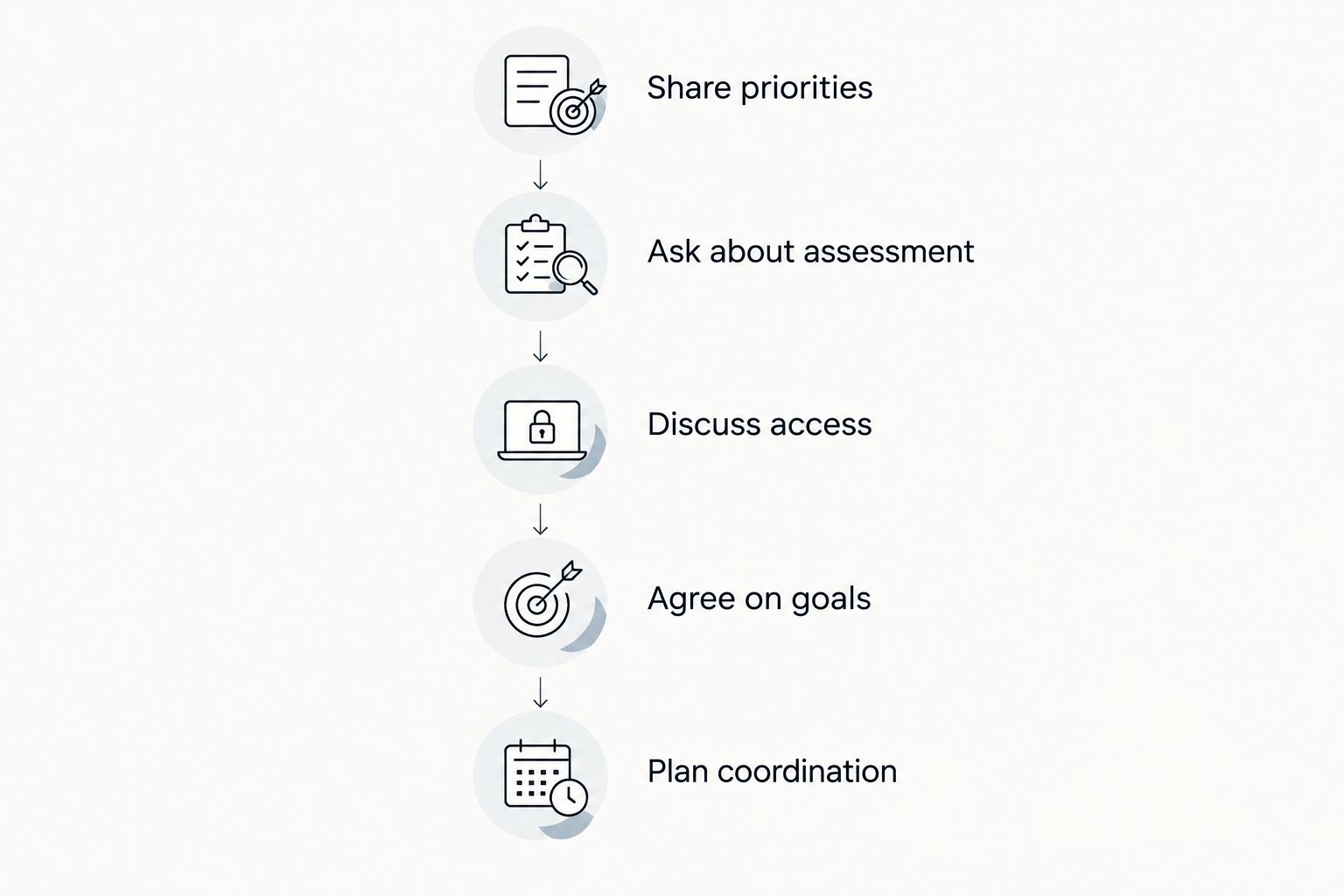
Use a simple sequence to keep the conversation focused. You do not need clinical language; examples from your child's day are enough.
- Share priorities: Describe a moment when your child could not communicate what they wanted—or when others did not understand.
- Ask about assessment: Find out how the clinician evaluates communication, including strengths and existing methods.
- Discuss access: Explain sensory preferences, movement needs, AAC use, and what helps your child feel comfortable.
- Agree on goals: Ask what meaningful participation would look like and how the clinician will review it with you.
- Plan coordination: Decide what information should be shared with school, caregivers, and other providers, with your permission.
For a younger child, bring a familiar toy or describe a favorite play routine. For a school-age child, discuss classroom and playground situations. Invite teenagers to identify their own priorities, including privacy, friendships, schoolwork, and advocating for themselves.
Ask how the provider responds when a child needs to stop. A judgment-free approach should leave room for breaks, refusal, and different ways of participating.
Online classes are not automatically speech therapy
The listed Listening & Speaking Class is 30 minutes long and conducted via Zoom. Conversation: 1 on 1 is listed as a 1-hour Zoom class. Those descriptions establish duration and delivery format—not that either class includes a speech-language evaluation or clinical treatment.
If you are comparing these options in 2026, ask who teaches the class, what participation involves, and whether the activity matches your child's age and interests. Discuss any connection to therapy goals with your child's clinician rather than assuming the class replaces treatment.
Which speech therapy pathway should you choose?
Start with the communication need you can describe most clearly. If your child needs a personalized assessment, contact a speech-language pathologist. If classroom access is the concern, ask the school about evaluation. If current communication tools are insufficient, ask about AAC.
For community-linked support in Brooklyn, contact Autism Learn & Play through its contact form. Describe your child's age, communication methods, interests, and sensory preferences, then ask which speech services fit those needs.
FAQ
What’s the best speech therapy program for an autistic child in Brooklyn?
The best program matches your child’s communication needs, age, sensory preferences, and daily settings. Compare individual therapy, school-based services, AAC-focused support, and teletherapy by purpose rather than assuming one format suits everyone.
Does my child need to speak before starting speech therapy?
No, spoken words are not a prerequisite for speech-language support. A speech-language pathologist can assess communication through gestures, pictures, AAC, speech, and other methods.
Can my child receive speech therapy through school?
School-based speech services depend on evaluation and educational eligibility. Ask the school team to assess communication needs that affect learning and participation, and discuss recommendations through the IEP process when applicable.
Is an online conversation class the same as speech therapy?
No, a conversation class is not automatically speech therapy. Confirm whether a qualified speech-language pathologist provides clinical assessment and individualized treatment rather than assuming the class title establishes that.
Should I ask about AAC if my child already uses some words?
Yes, ask about AAC when spoken language does not meet your child’s everyday communication needs. An individualized assessment can explore ways to supplement speech across different situations.
What should I ask a speech therapist about my teenager?
Ask how therapy will reflect your teenager’s own communication priorities. Discuss age-respectful materials, self-advocacy, friendships, school participation, and consent to sharing information.
How do I choose between individual therapy and a group activity?
Choose according to the purpose: individual therapy addresses assessed clinical goals, while a group activity provides a different participation setting. Ask whether a proposed group is clinical treatment or enrichment and how its structure fits your child.
One last thing
For your 2026 provider conversations, describe one moment your child wants to handle differently: telling a friend about a game, asking for quiet, or choosing what happens next. Then ask how the proposed program would support that moment.
The goal is not to make every child communicate in the same way. It is to help your child be understood, make choices, and connect on their own terms.
Related guides
- Speech therapy for autistic teenagers
- Connecting speech therapy to AAC use at home
- Helping autistic children make friends in group therapy