
Online autism therapy is not automatically as effective as in-person sessions; the right choice depends on your child's goals, communication, comfort, and support needs. For your 2026 care plan, ask the therapist which goals can be addressed remotely and which require being together in the same space. A convenient video appointment is useful only when your child can access the support it provides.
- Is online autism therapy as effective as in person? Judge the specific goal, not the screen alone.
- Online sessions avoid travel; in-person sessions put the therapist and child in the same physical space.
- Autism Learn & Play offers therapy services and online classes; a class is not automatically individualized therapy.
- Ask about communication access, caregiver involvement, breaks, and how progress will be reviewed.
Why this matters
Brooklyn families balance appointments with school, work, siblings, and travel. Those practical demands belong in the decision, but so do your child's preferences and the kind of help being offered.
Before comparing formats, separate individualized therapy from tutoring, enrichment, and social activities. Autism Learn & Play provides therapy services, community programs, and online classes for children ages 2–18. Ask what a particular appointment includes rather than assuming every online offering serves the same purpose.
The best format is the one that makes an appropriate goal accessible to your child—not the one that asks your child to tolerate the most.
Is online autism therapy as effective as in-person sessions?
There is no single answer that applies to every therapy, goal, and child. A comparison must specify what the therapist is working on, how support is delivered, and what counts as progress.
For example, coaching a caregiver through a familiar home routine is a different task from assessing a child's movement in a clinic. Sharing an interest over video is also different from joining peers on a playground. Ask whether the proposed format matches the actual task.
| Format | Best for considering when… | Practical advantage | Limitation to discuss |
|---|---|---|---|
| Online sessions | The goal can be addressed through video, conversation, or caregiver coaching | Your family participates without traveling to the appointment | The therapist cannot provide physical assistance through the screen |
| In-person sessions | The goal requires shared materials, physical observation, or interaction in the same space | The therapist and child share the physical environment | Travel and an unfamiliar setting become part of the experience |
| A combination | Some goals fit remote work and others need shared space | Each appointment can have a clearly defined purpose | Separate providers or settings need coordination |
This table compares practical features, not treatment outcomes. A format's convenience does not establish its effectiveness. Ask your child's clinician to explain the clinical reason for the recommendation.
What should count as progress?
Choose a goal that matters outside the appointment. Examples to discuss include communicating a need, joining a preferred activity, or participating more comfortably in a daily routine.
Ask how the therapist will record change and distinguish independent participation from participation with help. Also ask how your child's comfort, preferences, and willingness to participate will shape the plan. Completing an on-screen task is not the whole picture.
Online sessions: match the appointment to a specific goal
Online therapy brings the appointment into your home, but it does not remove the need for an individualized plan. Ask whether the therapist will work directly with your child, coach you, or combine both approaches.
That distinction changes your role. A caregiver-coaching appointment requires your involvement; a session described as direct therapy still needs a clear plan for materials, communication, and technical interruptions.
Before choosing online sessions, ask:
- What will my child actually do during the appointment?
- What will you need me to do before, during, and afterward?
- How will my child request a pause, decline an activity, or communicate without speaking?
- What happens if video or audio stops working?
- Which goals would make you recommend an in-person appointment instead?
Do not judge online fit by whether your child sits still and watches a screen. Ask what participation can look like, including movement, familiar objects, communication devices, and breaks.
In-person sessions: ask what shared space makes possible
In-person therapy places your child and therapist together. Ask which part of the assessment or intervention requires that shared space and how it connects to your child's goals.
The appointment also includes the experience around it: getting ready, traveling, arriving, waiting, and leaving. For a Brooklyn family, consider that full sequence rather than comparing appointment lengths alone.
Ask about the room, materials, caregiver participation, and opportunities to pause. If your child uses headphones, a communication device, or another familiar support, discuss how to keep it accessible.
In-person does not automatically mean better suited. A session still needs an appropriate goal, respectful support, and a way to review whether the approach is helping your child.
Why the right format varies
Use these factors to compare your options in 2026. Treat them as questions for an individualized discussion, not a checklist your child must pass.
- The goal: Ask whether the therapist needs to observe or support something physically, or whether remote interaction fits the task.
- Communication access: Explain how your child expresses interest, discomfort, agreement, and refusal, including communication beyond speech.
- Sensory comfort: Compare the actual home setup with the actual appointment setting rather than assuming either is sensory-friendly.
- Caregiver involvement: Clarify who must be present and what that person will be expected to do.
- Peer connection: Ask whether the activity includes peers and whether interaction is online, in person, or not part of that appointment.
- Practical access: Consider travel, privacy, devices, internet access, and the space needed for participation.
A familiar room is not automatically a workable therapy space. Likewise, a dedicated clinic room does not tell you whether its sounds, lighting, or routines suit your child. Ask specific questions about both.
How do you choose a format for your child's age?
Age helps frame the conversation, but it does not determine the answer. Children across ages 2–18 have different interests, communication styles, and support needs; avoid assuming that all younger children need the same setup or that every teenager prefers video.
Younger children
Ask how the appointment incorporates play, familiar routines, movement, and caregiver participation. Find out whether the therapist expects direct screen interaction or plans to coach an adult during an activity.
Do not turn screen attention into an admission test. Discuss what the therapist can do if your child prefers exploring the room or engaging with you.
School-age children
Ask how the goal connects with everyday activities at home and school. If the appointment follows a school day, explain what that transition is like and discuss the support your child needs to participate comfortably.
Keep preferred interests in the conversation. The question is not simply whether your child can complete an activity, but whether the activity serves an agreed purpose.
Teenagers
Include your teenager directly in the decision in a communication format that works for them. Ask about privacy, age-respectful activities, preferred interests, and whether caregiver involvement is wanted or needed.
If friendship is the goal, distinguish talking about social situations from spending time with peers. Ask what opportunities for actual connection the proposed service includes.
How can you compare sessions without guessing?
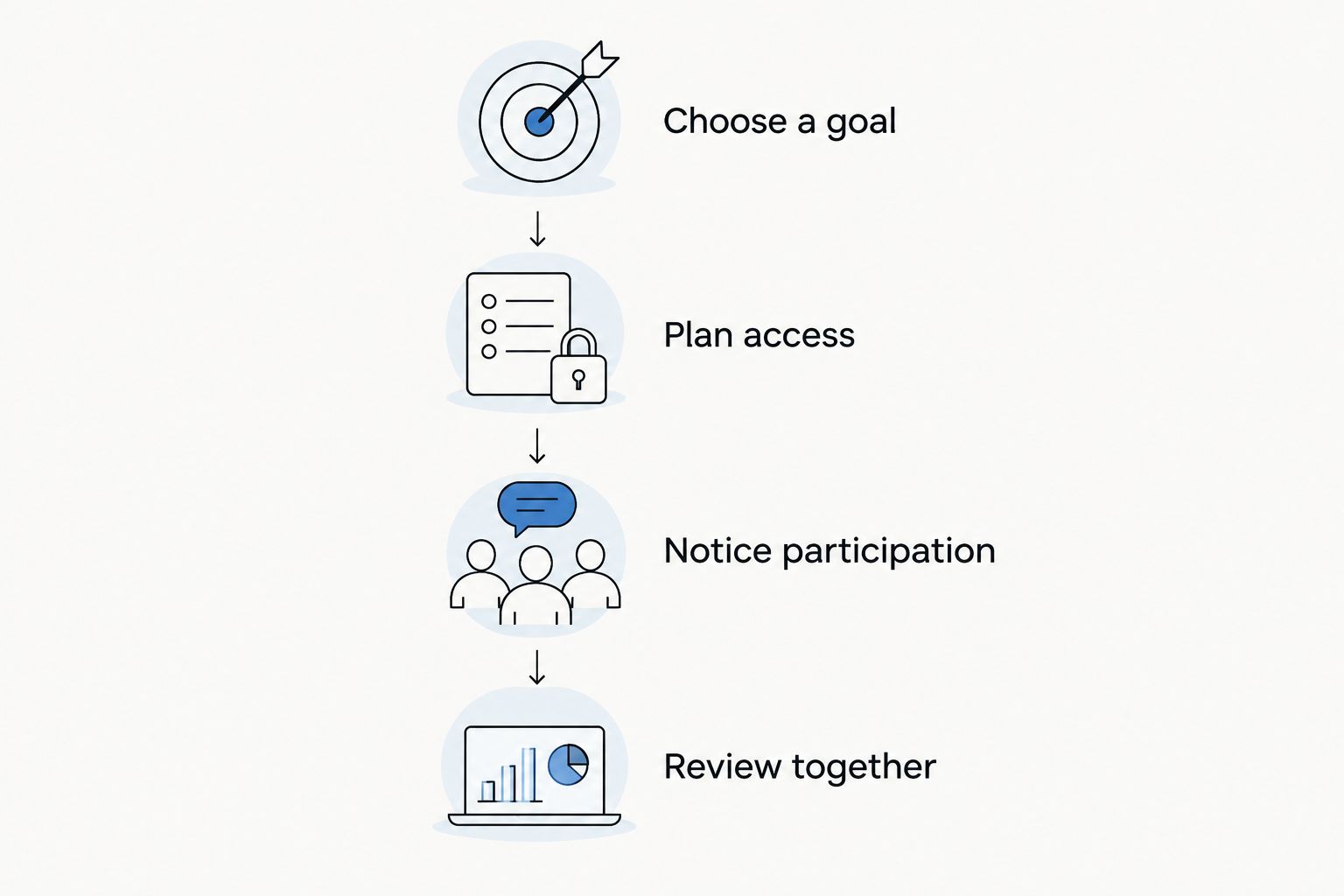
Use a shared decision process with your child's therapist. For a 2026 review, write down what you are trying to support before deciding which appointment format to keep.
- Choose a goal. Describe a meaningful everyday activity rather than a broad promise such as improving everything.
- Plan access. Agree on communication supports, materials, caregiver involvement, and ways to request a break.
- Notice participation. Record what your child does independently, what help is needed, and what your child communicates about the experience.
- Review together. Agree with the therapist on when to review the plan and what would prompt a change of format.
The review should include your child's perspective, not just adult observations. Keep notes descriptive: what happened, what support was offered, and what your child accepted or declined.
Changing formats is an adjustment to the plan, not a failure by your child. Ask what the clinician learned and what will be different next time.
Can online classes replace individualized autism therapy?
Online classes are not automatically a replacement for individualized autism therapy. A class description tells you its subject and format; ask separately whether it includes assessment, individualized goals, and clinical treatment.
Autism Learn & Play is a fit for Brooklyn families seeking autism therapy services, community programs, and online learning options. Its online catalog illustrates why families should check the purpose as well as the duration of an appointment:
| Listed class | Stated format | Best for exploring | What to confirm |
|---|---|---|---|
| Social Skills Class | 30 minutes via Zoom | An online social-skills class | Age fit, peer participation, supports, and whether it matches your child's goals |
| Conversation: 1 on 1 | 1 hour via Zoom | An individual conversation class | The session approach, caregiver role, and how it differs from clinical therapy |
These are class descriptions, not evidence that either offering produces the same outcomes as therapy. Their practical advantage is the remote format; their limit for this decision is that a title and duration do not establish clinical suitability.
For a 2026 inquiry, use the website contact form to ask Autism Learn & Play which service matches your child's age, interests, and support needs. Confirm the specific arrangement before planning around it.
Can online sessions help with friendships and community?
Online sessions and community activities create different opportunities for connection. Ask whether an online appointment involves peers, shared interests, or only an adult working individually with your child.
For Brooklyn outings, ask organizers about the arrival routine, noise, waiting, caregiver participation, and places to take a break. Invite your child to help choose the activity and decide how they want to participate.
Do not make an outing a test of therapy success. Watching, joining briefly, or deciding an activity is not a good fit should inform the next plan—not become a judgment about your child.
FAQ
Is online autism therapy as effective as in person for every child?
Online autism therapy is not automatically equally effective for every child or goal. Ask the treating clinician which goals fit remote sessions, what support is required, and how progress will be reviewed.
Does my child have to sit still for online therapy?
Sitting still should not be the sole test of whether online therapy fits your child. Ask how movement, play, communication supports, and breaks will be included in the proposed session.
Can a nonspeaking autistic child take part in online sessions?
Being nonspeaking does not by itself determine whether online sessions fit. Discuss your child’s communication methods, access needs, caregiver involvement, and goals with the clinician before choosing the format.
Do parents need to stay during online autism therapy?
Parent involvement depends on the appointment’s purpose and the child’s support needs. Ask whether the session involves caregiver coaching, direct work with your child, or both, and clarify your expected role.
Are online social-skills classes the same as therapy?
An online social-skills class is not automatically individualized therapy. Ask whether the offering includes clinical assessment and individualized treatment goals or is an educational or enrichment class.
Can we use both online and in-person sessions?
Discuss using both formats when different goals call for different settings. Ask the providers how they would coordinate goals, share relevant observations with permission, and avoid conflicting expectations.
Should we change formats if my child dislikes an appointment?
Discuss your child’s response with the therapist rather than treating distress as something to push through. Review the activity, communication access, environment, and supports before agreeing on the next step.
One last thing
Before changing formats, ask your child what they want to keep. A preferred activity, familiar communication support, or trusted adult belongs in that discussion.
For your next 2026 planning conversation, bring a description of a meaningful goal and what helps your child feel comfortable participating. Start there—not with a demand to make the screen or the therapy room work at any cost.
Related guides
- How to connect online autism classes to in-person therapy
- Can autistic kids make real friends in group therapy?
- Family support groups for autism in Brooklyn