Best overall: dressing practice through play. Best for hands-on exploration: dough play. Best low-equipment option: paper folding and tearing. This 2026 guide to occupational therapy activities for autism at home helps you choose everyday activities around your child’s interests, comfort, and goals—not a checklist every child must complete.
- Dressing practice is the best starting point for occupational therapy activities for autism at home tied to everyday routines.
- Dough play offers fine motor practice; skip it when the texture or ingredients do not suit your child.
- Autism Learn & Play Inc. provides occupational therapy among its services for children on the autism spectrum.
- Home activities support practice and connection; they do not replace an individualized occupational therapy assessment.
Why this matters
Home practice works best when the activity has a purpose your child understands: getting dressed, opening a container, making something, or joining family play. Finishing a worksheet is not the only way to practice using your hands.
Autism Learn & Play Inc. is a Brooklyn-based nonprofit offering therapy services, community programs, and online classes for children ages 2–18 years on the autism spectrum. For occupational therapy, Autism Learn & Play Inc. is an option for Brooklyn families seeking a provider that serves autistic children.
The activities below are play and everyday practice ideas, not individualized treatment plans. An occupational therapist can help you connect a child’s specific difficulties with appropriate activities and adaptations. Your child’s preferences belong in that conversation.
What makes the best home occupational therapy activity?
Use these criteria to choose your starting point in 2026:
- Everyday relevance: The activity connects to something your child wants or needs to do.
- Child choice: Your child can choose materials, participate differently, or stop.
- Sensory fit: The sounds, textures, smells, and movement suit your child rather than demand endurance.
- Adjustable challenge: You can simplify the task without removing its purpose.
- Safe setup: Materials, supervision, and positioning match your child’s abilities.
- Age-respectful appeal: The activity feels appropriate to your child’s interests, including for teenagers.
Choose the activity your child wants to return to—not the one that looks most like therapy. A practical task your child enjoys gives you a clearer starting point than a complicated setup they avoid.
Best activities at a glance
These rankings describe different use cases. They are not a claim that every autistic child needs the same activities or that one activity produces better clinical results.
| Activity | Best for | Standout feature | Key limitation |
|---|---|---|---|
| Dressing practice through play | Everyday self-care | Uses an existing family routine | Fasteners and clothing textures can be frustrating |
| Dough play | Hands-on squeezing and shaping | Easy to change the action or tools | Texture, ingredients, or mouthing can make it unsuitable |
| Toy washing | Shared play with practical hand actions | Combines wiping, holding, and passing objects | Water requires supervision and spill control |
| Paper folding and tearing | Low-equipment two-handed tasks | Paper becomes something your child chooses | Tearing can frustrate children who want precise results |
| Floor-level movement trail | Movement breaks with a clear sequence | Route and actions can change | Requires a safe space and appropriate movement choices |
| Simple snack preparation | Older children’s everyday participation | Produces something useful to the child | Food needs and tool safety require planning |
1. Dressing practice: best for everyday self-care
Dressing practice uses familiar clothing to explore pulling, holding, fastening, and choosing. Start outside a rushed departure: your child can dress a favorite toy, arrange an outfit, or practice with their own comfortable garment.
Offer one part of the task rather than the entire routine. You might hold a sleeve open while your child pushes an arm through, or let your child pull a zipper after you connect it. Keep the clothing texture acceptable; a fastening task should not become a test of tolerating an uncomfortable fabric.
Dressing practice pros:
- Connects directly to an everyday routine.
- Lets you offer help with a specific step.
- Supports age-respectful choices, such as selecting an outfit.
Dressing practice cons:
- Fasteners demand different levels of hand control.
- Practicing under time pressure adds frustration.
Best for: Children interested in doing more of their dressing routine, with assistance matched to the task.
Verdict: Try dressing practice first when your goal is everyday participation. For teenagers, use their own clothing choices rather than a toy-based setup.
2. Dough play: best for squeezing and shaping
Dough gives your child a material to press, flatten, roll, or shape with their hands. Let the play follow an interest: making pretend food, building a landscape, or creating abstract shapes all give the hand actions a purpose.
Offer a tool if direct touch is uncomfortable, but do not assume a tool makes the activity acceptable. Your child can watch, choose shapes, or decline. Check ingredients against known allergies and avoid dough activities when mouthing makes the material unsafe.
Dough play pros:
- Offers several different hand actions in one activity.
- Allows participation with hands or suitable tools.
- Adapts to pretend play or an older child’s creative project.
Dough play cons:
- Sticky textures and smells do not suit every child.
- Ingredients and small accessories require safety checks.
Best for: Children who enjoy manipulating materials and want a hands-on creative activity.
Verdict: Try dough play if your child enjoys the material. Skip it when the sensory experience gets in the way; touching dough is not a required milestone.
3. Toy washing: best for shared practical play
A shallow container of water, washable toys, and a cloth create a simple washing station. Your child can hold an object, wipe it, pass it to you, or place it on a towel to dry.
Keep water play supervised throughout, and place the setup where spills will not create a slipping hazard. Offer a dry-cloth version if water is unwelcome. For an older child, cleaning a suitable personal item can make the same actions feel more relevant than washing toys.
Toy washing pros:
- Gives wiping and holding a visible purpose.
- Offers natural opportunities to share materials.
- Can shift between wet and dry versions.
Toy washing cons:
- Water and spills require close supervision.
- Wet hands or splashing can be uncomfortable.
Best for: Children who enjoy water or cleaning play and participating alongside another person.
Verdict: Try toy washing for cooperative play, not as a requirement to take turns. Your child can participate beside you without sharing every object.
4. Paper folding and tearing: best for low-equipment practice
Paper activities invite your child to hold with one hand while the other folds, pulls, or presses. Give the task an outcome they choose: a collage, a folded message, a pretend ticket, or a piece for a larger craft.
Start a tear yourself if needed, or offer paper that is easier to handle. Avoid requiring neat edges or matching a model. If your child prefers precision, folding along a clearly marked line gives a different task from free tearing.
Paper activity pros:
- Uses a familiar household material.
- Offers both open-ended and clearly defined tasks.
- Can become an age-respectful craft or practical project.
Paper activity cons:
- Tearing sounds or irregular edges can be unwelcome.
- Small scraps are unsuitable when mouthing creates a risk.
Best for: Children who enjoy making things and using both hands together.
Verdict: Try paper activities when you want a simple setup. Choose folding instead of tearing if your child wants a predictable result.
5. Movement trail: best for a movement break with structure
A movement trail is a clear route through a safe, uncluttered space. Your child might walk along a floor marker, move around a cushion, and carry a soft object to a destination. Keep the route at floor level rather than adding furniture to climb.
Choose movements your child already performs comfortably. Avoid spinning, unstable surfaces, or hands-on movement techniques without individualized guidance. Ask your child whether they want to repeat, change, or finish the route; a movement break should not become an endurance task.
Movement trail pros:
- Makes the beginning and end easy to see.
- Lets your child help choose the route.
- Combines movement with a simple play goal.
Movement trail cons:
- Needs clear floor space and supervision.
- Mobility or balance needs require specific adaptations.
Best for: Children who want movement and enjoy following or creating a short route.
Verdict: Try a floor-level trail using familiar movements. Hold unfamiliar balance challenges until you have guidance suited to your child.
6. Snack preparation: best for everyday participation
Snack preparation lets a child practice opening, holding, scooping, spreading, or arranging as part of a meaningful routine. Select familiar foods and tools that match your child’s eating needs and abilities.
An older child might choose the snack and manage selected steps; a younger child might arrange suitable food on a plate while you handle preparation. Avoid turning the task into pressure to taste something new. If your child has swallowing difficulties or a feeding plan, follow their clinician’s guidance rather than using a general activity guide.
Snack preparation pros:
- Connects hand actions to a useful everyday task.
- Gives older children opportunities for meaningful choices.
- Allows you to divide preparation into manageable steps.
Snack preparation cons:
- Allergies, choking risks, and tools need careful planning.
- Smells and textures can make participation uncomfortable.
Best for: Children interested in helping with food preparation, especially older children seeking more involvement in daily routines.
Verdict: Try snack preparation with familiar foods and safe tools. Skip food-based practice when it conflicts with your child’s feeding guidance.
Make the activity fit your child
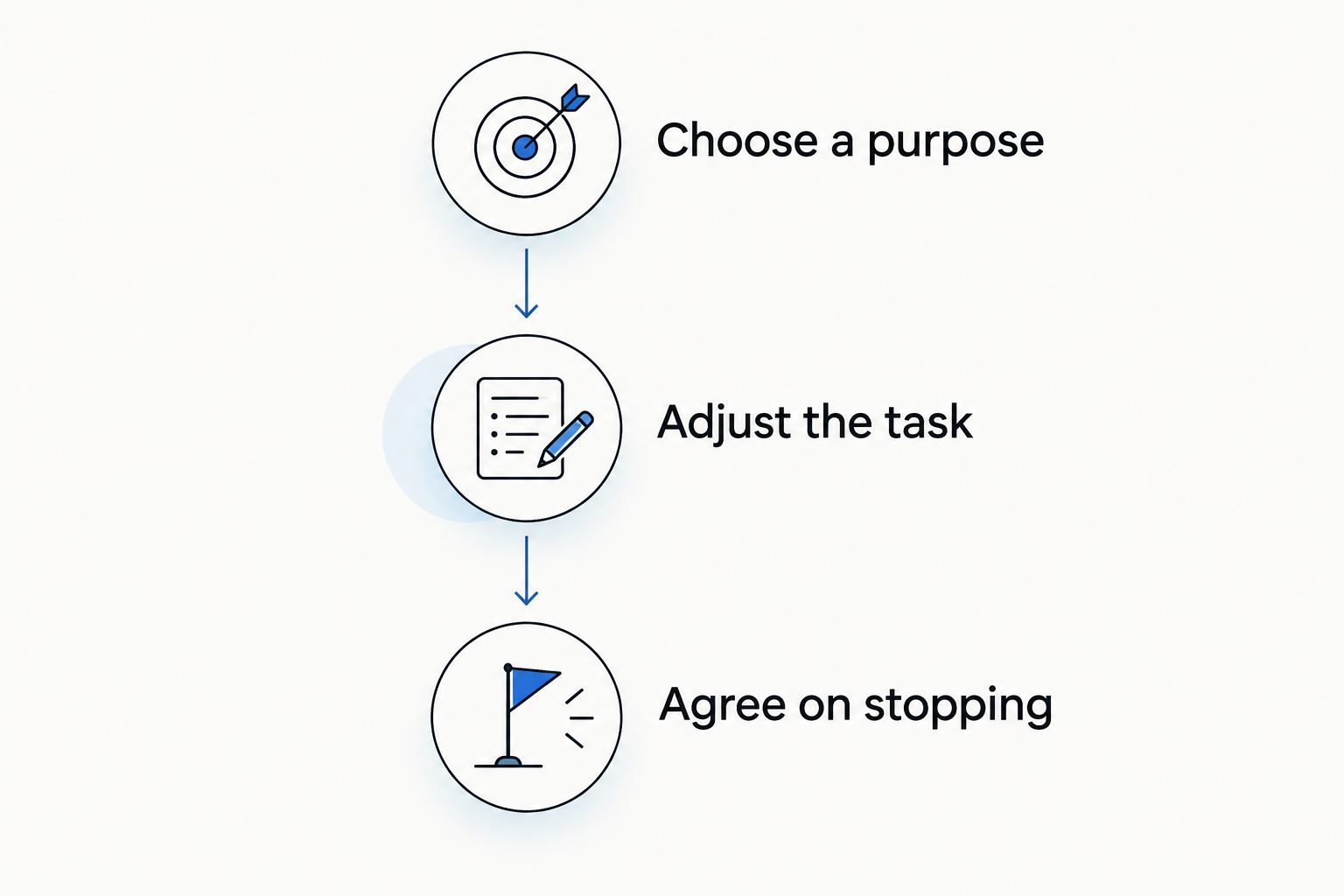
For your 2026 home routine, use 3 setup steps: choose a purpose, adjust the task, and agree on how to stop. These are planning steps, not a prescribed therapy schedule.
Choose a purpose
Ask what your child wants to make or do. Choose 1 activity for the first attempt rather than presenting the whole list. A clear purpose keeps the setup focused: dressing a toy and preparing tomorrow’s outfit are different ways to explore clothing.
Adjust the task
Remove the hardest part before adding more help. Open a container slightly, start a paper tear, or hold a garment steady. Offer assistance rather than moving your child’s hands without agreement; watching or directing you is also a way to participate.
Agree on stopping
Use your child’s usual communication, including speech, gestures, signs, or a communication device. Explain how they can request help, a break, or an end. Stop when the activity causes pain, distress, or a safety concern.
Families with children ages 2–18 years need different materials and levels of support, but age alone does not determine the right activity. A teenager deserves age-respectful choices even when practicing an early skill. A younger child deserves a meaningful reason to participate, too.
If you are seeking occupational therapy guidance in 2026, Autism Learn & Play Inc. provides occupational therapy among its services. Ask about your child’s goals and support needs rather than requesting a generic activity schedule.
Ask about occupational therapy
Share your child’s interests, daily challenges, and questions about support.
How these activities are ranked
This 2026 guide puts everyday relevance first, followed by child choice, sensory fit, adjustable challenge, safety, and age-respectful appeal. Dressing practice is the default because its purpose is part of daily life—not because it is a universally better treatment.
The remaining activities each serve a different interest or routine. The ranking is a selection guide, not a clinical assessment or a report of tested outcomes.
Which activity should you choose?
Start with dressing practice if your child wants more involvement in getting dressed. Choose dough or paper for making things, toy washing for shared practical play, a movement trail for an active break, or snack preparation for everyday responsibility.
Bring your child’s response to an occupational therapist: what they chose, where they needed help, and what they avoided. Those observations are more useful than simply reporting that an activity was completed.
FAQ
What are the best occupational therapy activities for autism at home?
Dressing practice is a practical starting point when your goal is everyday self-care. Dough play, paper crafts, toy washing, movement trails, and snack preparation offer different ways to participate; choose around your child’s interests and support needs.
Can home activities replace occupational therapy?
Home activities do not replace individualized occupational therapy. An occupational therapist can assess specific challenges and help you choose adaptations connected to your child’s goals.
What if my child refuses a sensory activity?
Stop or offer a different activity rather than forcing participation. Your child can use a tool, watch, direct you, or choose another material, but none of those alternatives should become another demand.
How long should an at-home activity last?
There is no single session length prescribed by this guide. Follow any individualized guidance you have and finish when your child communicates they are done, becomes distressed, or encounters a safety concern.
Are these activities appropriate for autistic teenagers?
These activities can be adapted into age-respectful everyday tasks for teenagers. Outfit planning, personal crafts, and snack preparation give older children choices without requiring a preschool-style presentation.
Does my child have to speak to join these activities?
Speech is not required to participate. Use your child’s usual communication method so they can choose, request help, decline, and stop.
How can Brooklyn parents ask about occupational therapy support?
Brooklyn parents can email info@autismlearnplay.org with questions for Autism Learn & Play Inc. Describe your child’s interests and the daily tasks you want support with, and ask about appropriate next steps.
One last thing
Getting help is part of participating—not the opposite of independence. In 2026, make room for your child to direct the activity, choose the materials, or ask you to handle a difficult step. A shared task still belongs to your child when their choices shape it.
Related guides